For in that sleep: what depression feels like

what dreams


Sixteen years ago my brother sat in a cozy chair in front of a picture window that allowed him a view of the Strait of Juan de Fuca and ended his life.  He used a gun. The bullet tore through his brain and his family’s hearts.  We stopped breathing for years.  We told ourselves that he chose this because he was in constant pain. His spine was beginning to stiffen; he could not raise his head.  He went sock-less, because it was too difficult to pull them on.

It wasn’t just physical pain.  My brother suffered from depression long before the arthritis that immobilized his spine set in.  Like the color of our eyes or the set of our jaws, depression, anxiety, and addiction are characteristics that run in my family on both sides.

And, for the most part, we don’t talk about it.

I was a teenager the first time I thought about dying.  I took a fist full of aspirin, hoping it would — while also hoping it wouldn’t — be enough to send me to sleep for good.  My ears rang for days and my stomach burned.  Sometimes I felt so inexplicably sad and so utterly weary that I would simply start to cry.  If someone asked me why, I couldn’t give them a reason.  I didn’t sleep well.  Especially on nights when my father was particularly restless and drinking a lot.  I knew there were times when he thought of dying as an escape.  In the dark I stayed awake to listen, fearful that if he went, he’d try take the rest of us with him.

After high school I moved half-way across the country.  I made friends.  I drank too much, I still cried, but only when I was alone.  I laughed like hell with my friends; I was charming and fun.  My eyes darted around the room as I wondered whether anyone would guess how miserable I really was.  I felt like my feet were encased in cement — if I fell in a river, I’d drown.

I wanted just to be happy, to be normal.  I wanted to know what was wrong with me.  I kept those wants to myself.  I thought that in thinking about my unhappiness, I was wallowing in self-pity.  People wouldn’t want to be around me, if they knew.

Eventually, stress and the struggle drove me to the third story edge of an open floor on the house my husband and I were building.  I was alone there that afternoon.  I knew that if I let myself go, my family would assume I’d fallen accidentally.  I was afraid of heights.  There would be no shame.

I chose therapy instead.

Today, I am an ongoing work-in-progress.  I don’t know that depression ever completely goes away.  Even after years of therapy, and many more years of taking antidepressants, I sometimes still get blindsided by a cavity of despair so dark and deep, it seems never-ending.  Other times depression hits me with a flip-flop of emotions, wildly fluctuating from bleak despair to . . . Okay, I’m coping . . . wait . . . nope . . . going dark again.  Often, in the space of 30 minutes or so.  I have to talk to myself a lot.

Sometimes, I just want to hide.  I want to go into my room and not answer the phone or answer emails.  Mostly, I don’t want to tell anyone when I’m depressed. Generally, they don’t understand.  People seem to want an explanation as to why.

I’ve learned when I need to ride out the storm.  I know that when I’m tired and overwhelmed by things my husband and others take in stride; when I get so busy I don’t eat well (or enough), or when the damn world is just too much with me, I have to retreat for a bit and simply be quiet.

A great deal of the time I am happy with where I’m at, content with how I got here.  I laugh a lot and mean it now.  Managing depression is work, but so is living, even in the best of times.  We all struggle with something.

Several months after my brother’s suicide, my family got together, still raw and hurting from our loss.  We went to see What Dreams May Come.  I think we must have thought it would be cathartic.  It wasn’t.  The vision of Hell reserved for the woman who took her life horrified me.

Robin Williams’ suicide makes me crushingly sad.  It’s the kind of heavy sorrow that weighs me down.  He was the brother/son/father/friend we all wished we knew.  A rapid-fire wit with a thousand different characters, the genius of which we are unlikely to see again.  We all knew about his problems with alcohol and cocaine.  Addiction is flashy and loud and calls attention to itself.  Depression is a quiet little liar and a sneak.  It whispers in your ear and tells you lies that no one hears but you.  Robin joked openly about his battle with addiction.  He said little publicly about depression.

I hope that we start talking more openly about depression.  About how quiet, but debilitating it can be.  It won’t be easy.  I have a difficult time talking to anyone other than my husband and a few friends about it.  When I do, I feel awkward and whiny and I end up changing the subject.

For my brother, for a sweet prince of laughter, and for all the other voices stilled, please keep talking about depression.  Keep listening.  Listening without judgement, without asking why.  Be kind.  And if you or someone you know feels worthless and depressed, you can find someone to talk to here.



Shine a light

Tom with fire.jpg My brother and his trusty Bic lighter.

The boy in the photo above is my brother Tom.  My mother named him Thomas, but we all called him Tommy.  At seventeen he dubbed himself Tomas (pronounced toe-mas, accent on the second syllable).  He took to wearing sunglasses and being quietly mysterious.  It was the first of many personas he would try on for size while looking for how he fit in the world.

It wasn’t easy for him, figuring it out.  He had a handicap from the start: Youngest of seven; born colicky, and needing a lot of soothing in a busy, boisterous family. He was often lost in the fray.

At two he fell through the heating vent in the bedroom floor, bumped accidentally by another brother as they jumped on my parents’ bed.  He landed in the dining room below, barely missing the table. Astonishingly, other than scaring the hell out of us, and knocking the wind out of himself, he was fine.

When he was three, I dumped scalding hot food on him.  Also an accident.  A pressure cooker containing what was meant to be our dinner exploded when I tried to lift the lid.  Tommy was standing by my side.  I was blown backwards, while lava-hot meat and potatoes shot straight up from the pot and rained down on his back.  I can’t remember how long he was in the hospital, but I do remember feeding him ice cream there.  The scars never went away.

After that he managed to make it through the rest of his childhood and adolescence with only the usual bumps and scrapes.  But he was always kind of quiet and a little aloof.  He liked to climb trees where he would sit for hours looking out at the world.  I asked him a few times what he thought about up there, but he wouldn’t tell me.  I think he was dreaming what life could be.

Tommy lived with me three times in my life, beginning when he was Tomas at seventeen.  I lived in Colorado then.  He wanted to finish his last year in high school somewhere other than where he was born.  We joined the local Y and worked out together, ran around the indoor track together, then went for donuts afterwards.  He wore his sunglasses and skipped classes and shared falafel with the homeless guys who hung out in the park.  At the end of the year he went back to my mother.

The next time he came to live with me I had just moved to Rhode Island.  He slept in my basement and got a job as a cook in a nursing home within walking distance of my apartment.  Eventually he met someone, and moved in with her.  He got a job at Electric Boat and learned how to weld the seams of atomic submarines.  In his down time he helped my husband and I build our house.

He had a baby with the woman he lived with, a boy who looked a lot like him.  He took photos and put them in an album where he wrote things like from father to son and, a man with song and dance not to mention poise across the pages. Then the woman took the baby out of state and had Tom sign a paper relinquishing his paternal rights.  He signed it because “it was what she wanted”, but it broke his heart to do so.  He never saw his son again.

He tried to fill the hole by being a fabulous uncle to his nephews.  He took them for walks and held their hands and watched cartoons with them.  He listened to their dreams and understood.

The last time Tom lived with me his life had begun to unravel.  By then he’d been diagnosed with a disease that would increasingly stiffen his spine and cause him pain.  A few days after he moved in with us, he simply stopped going to work.  He was tired of smacking his head on the insides of the submarines he was welding.

When I turned 35 Tom told me that I was old, being just 5 years from 40, as though 40 was near to the end of it all.  He must have believed that, since he took himself out of the equation at 33.  I’ve written about that choice in a more oblique form elsewhere on this blog.

Today is Tommy’s birthday.  By his thinking he would be old.  To the rest of my siblings–Amy, Kathy, Jaime, S.K.–and myself, he is still and will always be the youngest, the most fragile of us all who, nevertheless, keeps us buoyed and connected to one another by the memory of his life.

Happy Birthday, little brother.  Tonight the light in my window shines for you.

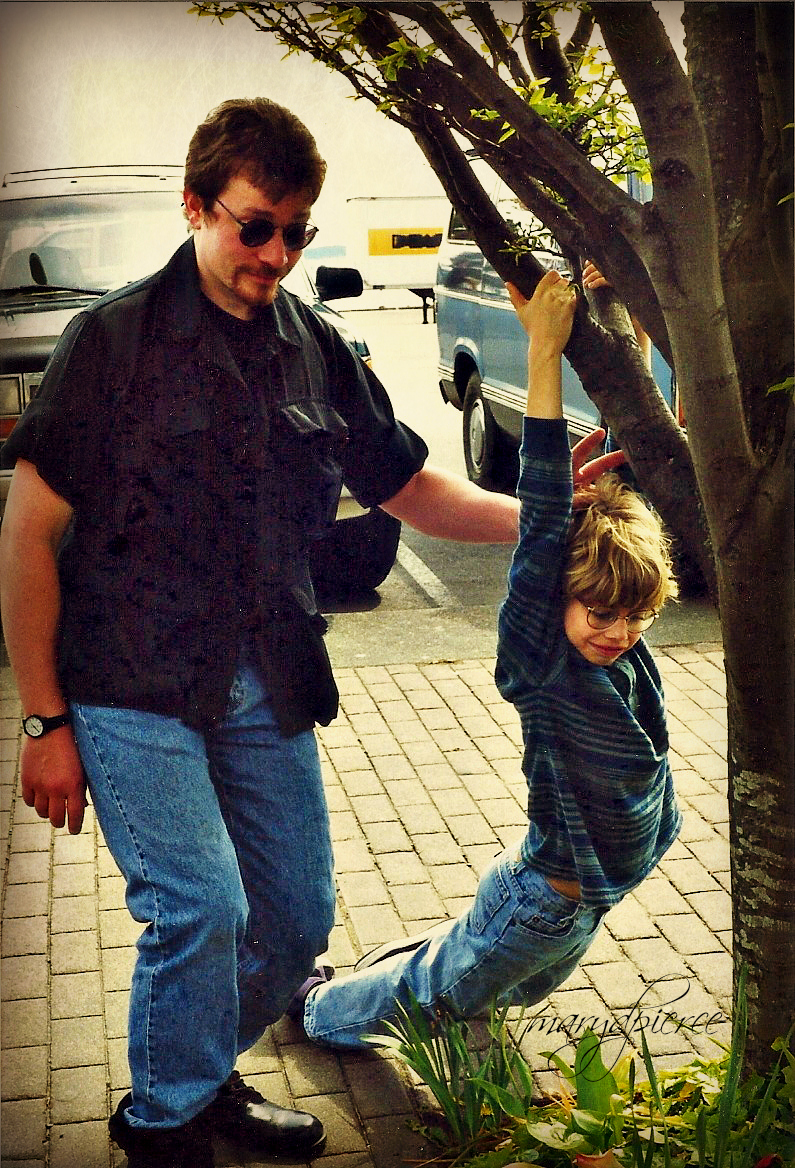
Uncle Tommy with my the Boy, taken two weeks before he left us on our own. Uncle Tommy with my Boy, taken two weeks before he died.

Not waving, but drowning . . . .

Not Waving but Drowning

Nobody heard him, the dead man,
But still he lay moaning:
I was much further out than you thought
And not waving but drowning.

Poor chap, he always loved larking
And now he’s dead
It must have been too cold for him his heart gave way,
They said.

Oh, no no no, it was too cold always
(Still the dead one lay moaning)
I was much too far out all my life
And not waving but drowning.

Stevie Smith

I had planned on posting a piece about the end of my summer.  But, then I was reminded that today is World Suicide Prevention Day.   And I thought about how on May 6th, fourteen years ago, my brother, the baby of the family, sat in the same lounge chair that he often slept in, and ended his life.

Depression is an insidious disease.  Statistically, more people in the world die from suicide than from war and murder combined.  I can understand why:  Life is full of misery and hardship.   There are moments in almost every day that I think this.  But there are also moments in every day when I find something to feel good about or laugh at, and that is enough for me.  That, and having a wonderfully funny son, a loving husband, family, and friends.

My brother and I talked about a lot of things, but we danced around the possibility of suicide.  I worried that if I said the word aloud it would make the possibility more real.

So, let’s talk about it, people.  You can find help and resources here.  Or call 800-273-TALK (8255) now.

Let’s not be afraid to say it:  Don’t die.

Please.

My brother, Tom. Taken on my last visit with him, a few weeks before he died.