Collecting details: In the bleak midwinter

Observing, collecting details as “glimmers of a beginning.”  A way of finding a story to tell.  That was the challenge this week.
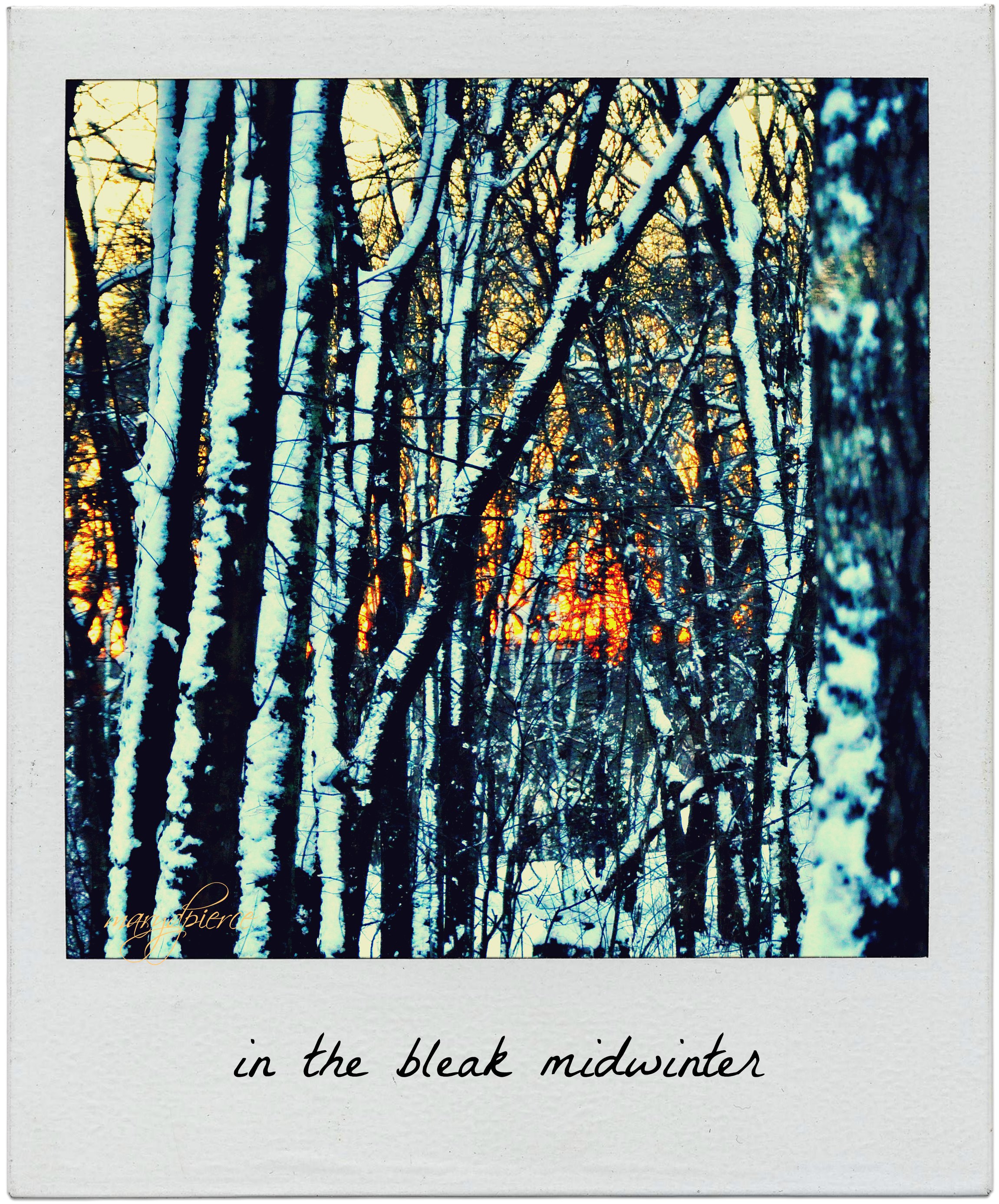
in the bleak midwinter

Somewhere outside my window a machine hums incessantly for the second day in a row.  Its motor drones, the constant whirring sound punctuated by louder grinding noises.  Like a monster being fed, its appetite is ravenous.  It will not be sated.  My husband would be at the window checking to see where the sound is coming from, which neighbor has wood to chip this time of year.  But my husband is at work.  And I am too lazy, too disinterested to check out where Smaug is being used.  It doesn’t really matter in whose yard the machine/monster feeds.  Noise is noise.

Our yard has lots of trees and an overabundance of bittersweet.  The vine sidles up alongside the trees, curling a sinuous path out along limbs, growing thick and woody until it has strangled the life from the tree.  In the green of spring and summer it’s harder to notice the bittersweet in its sneaky trail below a layer of dirt, pushing through shrubs and other plantings.  We hack at it and pull it up, but it is incessant and wears us out.  Now, in the bleak midwinter, it is easy to see.  The vine coils around some of the trees, already thick as rope.

It’s the chill this time of year that I mistrust.  The trees stand like stark centurions behind the house, the only time I can see a sliver of the lake that lay beyond them.  The sky cracks like a sheet of glass.  Fingers feel fat and numb in no time in weather like this.  Why would anyone stand outside and feed wood to a machine?  I imagine how easily a monster like that could steal a finger or two.  There are no do-overs then.

A lawyer I know once defended a man who disposed of his wife with a wood chipper.  The lawyer is a kind man, softly rumpled, with hair just long enough to show a tendency to wave.  He wears sports coats and carries a leather brief case that looks like it was a gift when he graduated law school.  He has a fondness for Mark Twain, and reminds me of Atticus Finch.  I wonder what Atticus would make of a man who rid himself of his wife by such ugly means.  There is no nobility in defending such a person.  I expect the lawyer had his reasons.  He enjoys reading Twain, after all.

Shine a light

Tom with fire.jpg My brother and his trusty Bic lighter.

The boy in the photo above is my brother Tom.  My mother named him Thomas, but we all called him Tommy.  At seventeen he dubbed himself Tomas (pronounced toe-mas, accent on the second syllable).  He took to wearing sunglasses and being quietly mysterious.  It was the first of many personas he would try on for size while looking for how he fit in the world.

It wasn’t easy for him, figuring it out.  He had a handicap from the start: Youngest of seven; born colicky, and needing a lot of soothing in a busy, boisterous family. He was often lost in the fray.

At two he fell through the heating vent in the bedroom floor, bumped accidentally by another brother as they jumped on my parents’ bed.  He landed in the dining room below, barely missing the table. Astonishingly, other than scaring the hell out of us, and knocking the wind out of himself, he was fine.

When he was three, I dumped scalding hot food on him.  Also an accident.  A pressure cooker containing what was meant to be our dinner exploded when I tried to lift the lid.  Tommy was standing by my side.  I was blown backwards, while lava-hot meat and potatoes shot straight up from the pot and rained down on his back.  I can’t remember how long he was in the hospital, but I do remember feeding him ice cream there.  The scars never went away.

After that he managed to make it through the rest of his childhood and adolescence with only the usual bumps and scrapes.  But he was always kind of quiet and a little aloof.  He liked to climb trees where he would sit for hours looking out at the world.  I asked him a few times what he thought about up there, but he wouldn’t tell me.  I think he was dreaming what life could be.

Tommy lived with me three times in my life, beginning when he was Tomas at seventeen.  I lived in Colorado then.  He wanted to finish his last year in high school somewhere other than where he was born.  We joined the local Y and worked out together, ran around the indoor track together, then went for donuts afterwards.  He wore his sunglasses and skipped classes and shared falafel with the homeless guys who hung out in the park.  At the end of the year he went back to my mother.

The next time he came to live with me I had just moved to Rhode Island.  He slept in my basement and got a job as a cook in a nursing home within walking distance of my apartment.  Eventually he met someone, and moved in with her.  He got a job at Electric Boat and learned how to weld the seams of atomic submarines.  In his down time he helped my husband and I build our house.

He had a baby with the woman he lived with, a boy who looked a lot like him.  He took photos and put them in an album where he wrote things like from father to son and, a man with song and dance not to mention poise across the pages. Then the woman took the baby out of state and had Tom sign a paper relinquishing his paternal rights.  He signed it because “it was what she wanted”, but it broke his heart to do so.  He never saw his son again.

He tried to fill the hole by being a fabulous uncle to his nephews.  He took them for walks and held their hands and watched cartoons with them.  He listened to their dreams and understood.

The last time Tom lived with me his life had begun to unravel.  By then he’d been diagnosed with a disease that would increasingly stiffen his spine and cause him pain.  A few days after he moved in with us, he simply stopped going to work.  He was tired of smacking his head on the insides of the submarines he was welding.

When I turned 35 Tom told me that I was old, being just 5 years from 40, as though 40 was near to the end of it all.  He must have believed that, since he took himself out of the equation at 33.  I’ve written about that choice in a more oblique form elsewhere on this blog.

Today is Tommy’s birthday.  By his thinking he would be old.  To the rest of my siblings–Amy, Kathy, Jaime, S.K.–and myself, he is still and will always be the youngest, the most fragile of us all who, nevertheless, keeps us buoyed and connected to one another by the memory of his life.

Happy Birthday, little brother.  Tonight the light in my window shines for you.

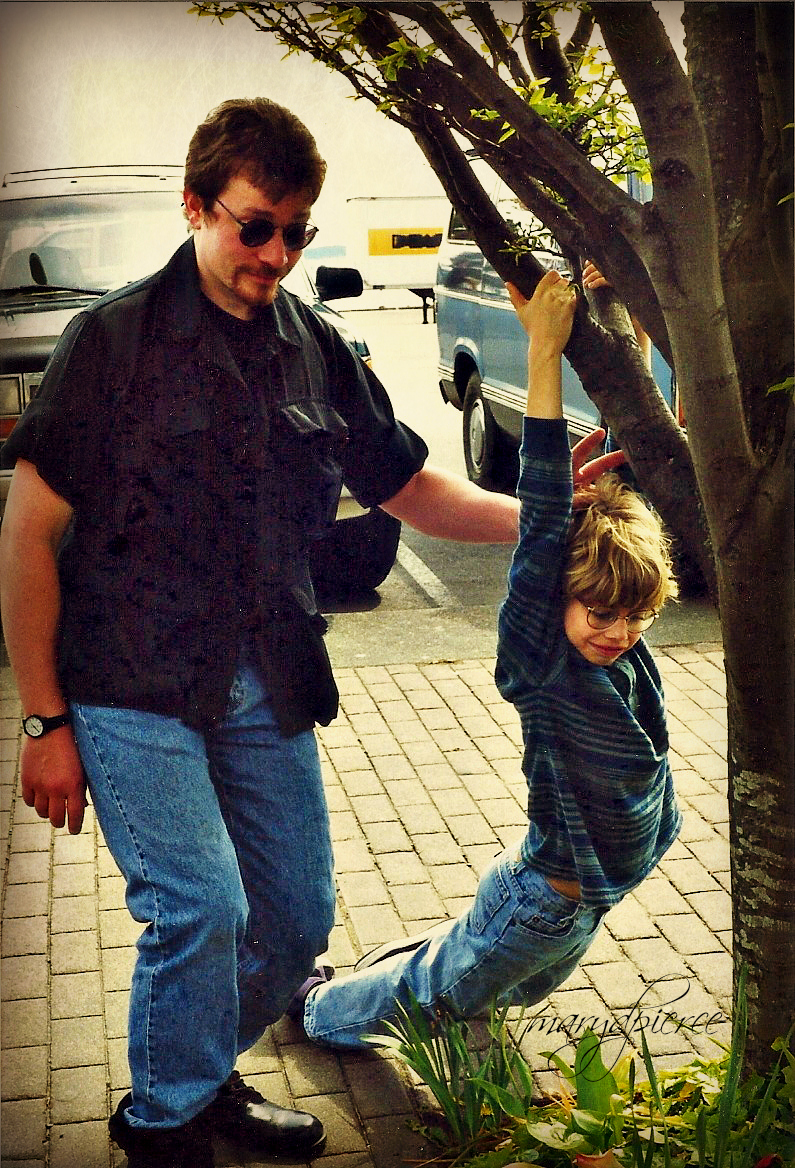
Uncle Tommy with my the Boy, taken two weeks before he left us on our own. Uncle Tommy with my Boy, taken two weeks before he died.

While my heart gently sings

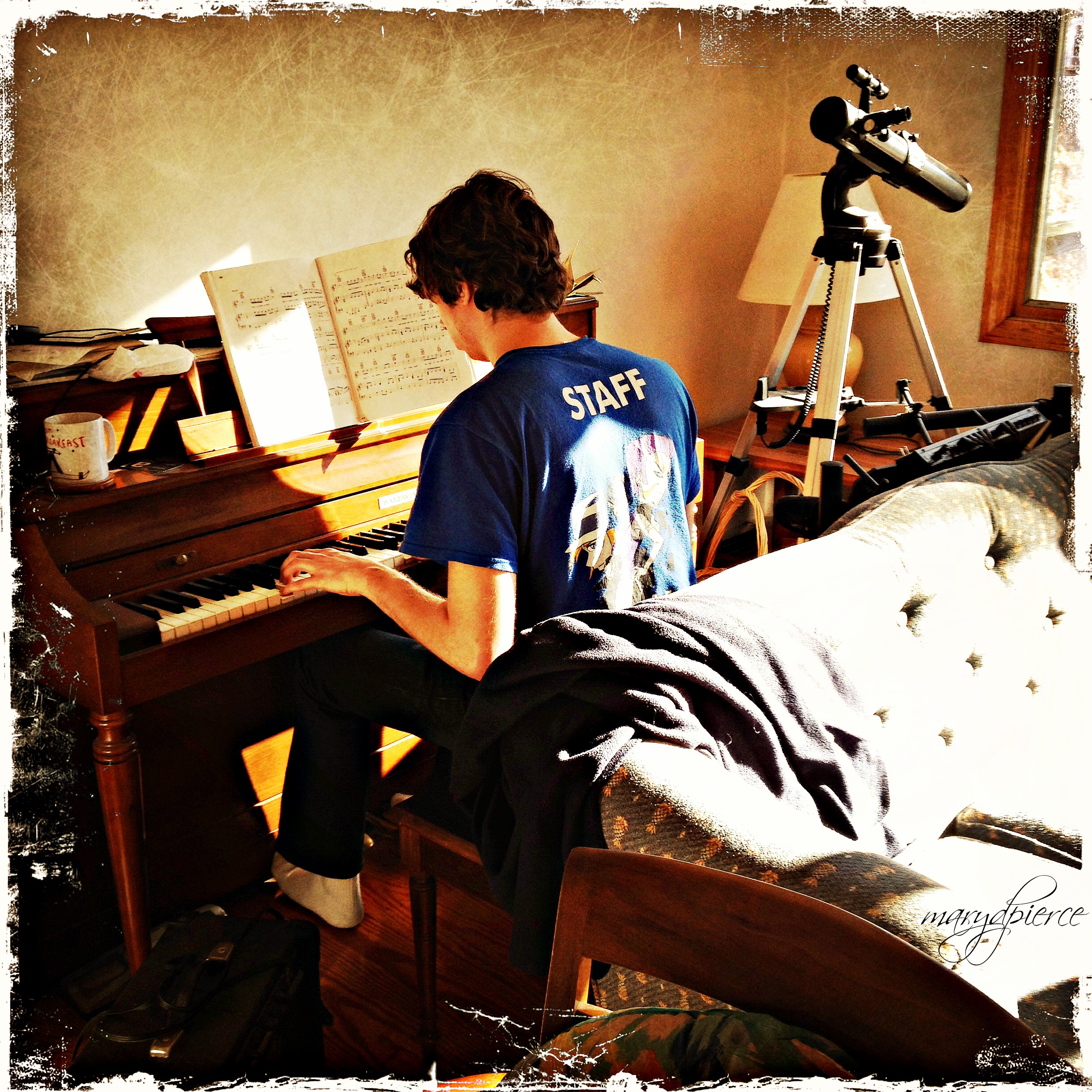
The Boy is home.  Which is, in itself, a joyous event, but he is also playing the piano in the den.  The sun is bright, near-white from the frigid air outside, but slanting through the window it brings in only warmth that spills across the room. The music rides the sun’s coattails and radiates through the entire house.

What more could one wish for in life than this?

The boy plays, my heart sings. . . .

The Boy plays, and my heart sings. . . .

We are all contributing to the meal today.  My husband is doing the mashed potatoes because no one mashes potatoes like him.  The Boy is giving us his version of mac-n-cheese.  I’m doing the roast and the vegetables.  I’ve made brownies for dessert, extra dark and extra fudgey.   It’s all about easy-peasy today.  And togetherness.

There are no pilgrim hats or cornucopias overflowing with fruit on our table.  I didn’t make a pie.  We are a small group, the three of us, and we are not big eaters.  This year we’re shooting for something more intangible than mountains of food.  Something to fill our spirits rather than our bellies (though our bellies will do well enough). The cherry on the top of our day will be when we settle in to our comfy living room later and listen while the Boy reads aloud the last 50 or so pages of Fahrenheit 451 because I haven’t managed to finish reading it yet, and it’s time.  It is most definitely time.

Oh, that we were all wealthy in love and good will.  That everyone could be kind.  For the wonderful people I am blessed to love and care about (and there are a LOT of you out there) I wish you all that and more.  I wish you peace and gratitude wherever you may be.  Here’s to filling your souls to overflowing.

Because it’s time.

Cleaning house

As I am wont to do periodically, I have gone quiet.  The truth is, that sometimes the world is too much with me.  This is a time when I hunker down, take stock, recharge, rethink, re-plan.  It used to worry me, these periods of introspection. Now we know so much more about things like depression and how introverts function, and I have learned to ride it out.

One of the things I’ve been thinking about, is that it’s time to clean out my house. And not just metaphorically.  After twenty-six years living with the same man in the same house, we have accumulated a lot of stuff.  After a while the stuff gets in my way.

I’m focusing first on my studio.  The room that houses most of my books and all my art supplies.  (I’d include a photo, except that it would embarrass me to no end to have you see how neglectful I’ve been — my family knows what I’m talking about, ask them.)  It’s also the room where I exercise, write and do all my creative work, the room where my muse resides. She is not happy with the mess.

I’m on a mission here:  Pay heed to my muse and get rid of a lot of stuff.  So, if you haven’t heard from me in awhile, this is where I’m at.

I’ll be back momentarily.  I promise.  In the meantime, I’ll leave you with this little tidbit.  Something I found in one of the many notebooks I have scattered around the room like old shoes.  I rarely date things, so I have no idea when I wrote this, nor do I remember what its purpose was, other than that I do have reoccurring dreams of flying.

Enjoy.

In dreams, I fly, though there are no wings budding from my back like tender shoots that blossom on spring trees.  No feathers fanning in orgasmic waves behind me. There are just my arms — flesh and blood and bone — to lift me, weightless as a dime while I circle above my oldest fears, childhood tormentors grown fat, and unrecognizable, wearing clown pants and floppy shoes.

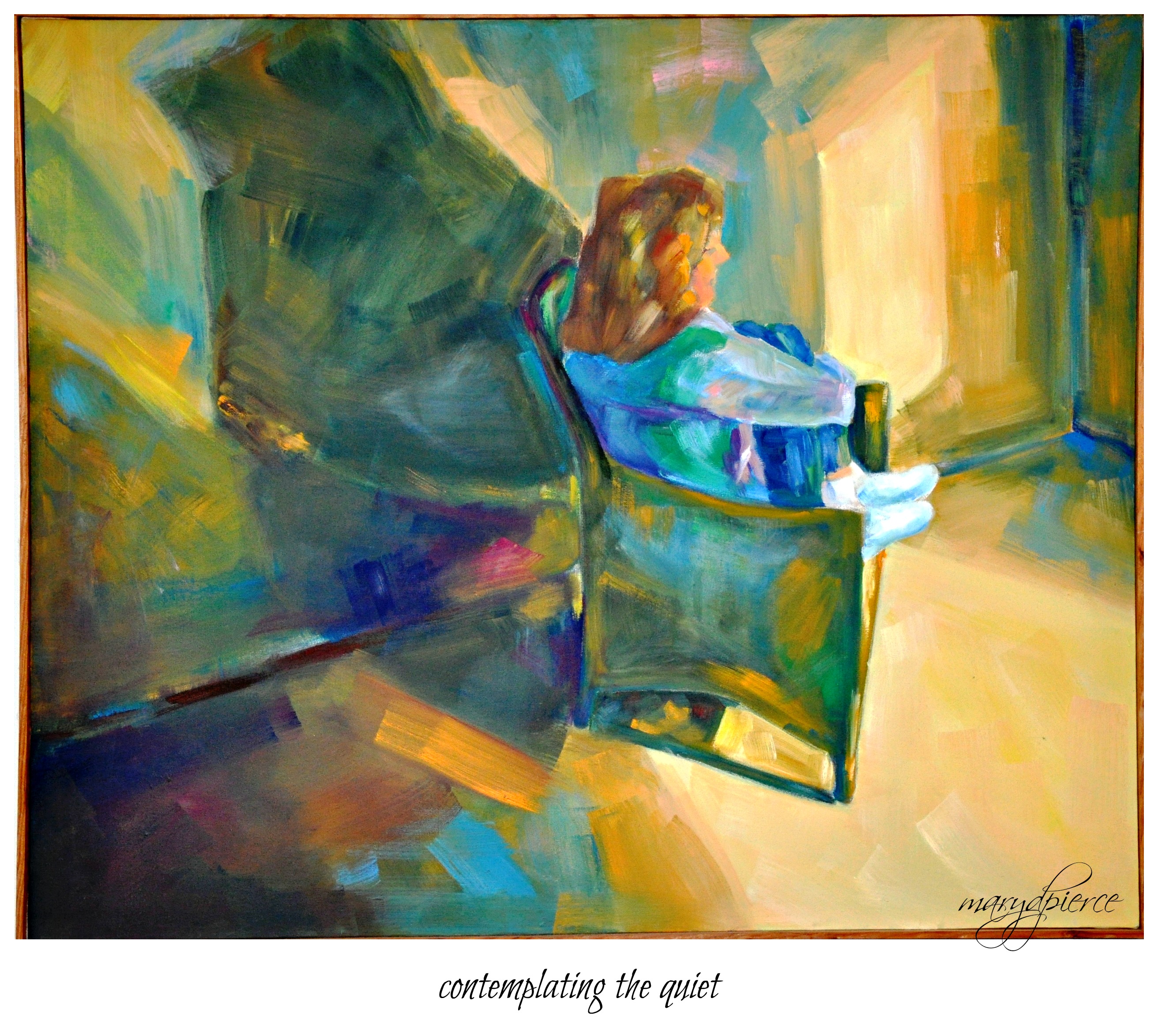
Being quiet pm

And this . . . painted while I was in college and my house had hardly any stuff at all.

“Kill the Indian, and save the man.”

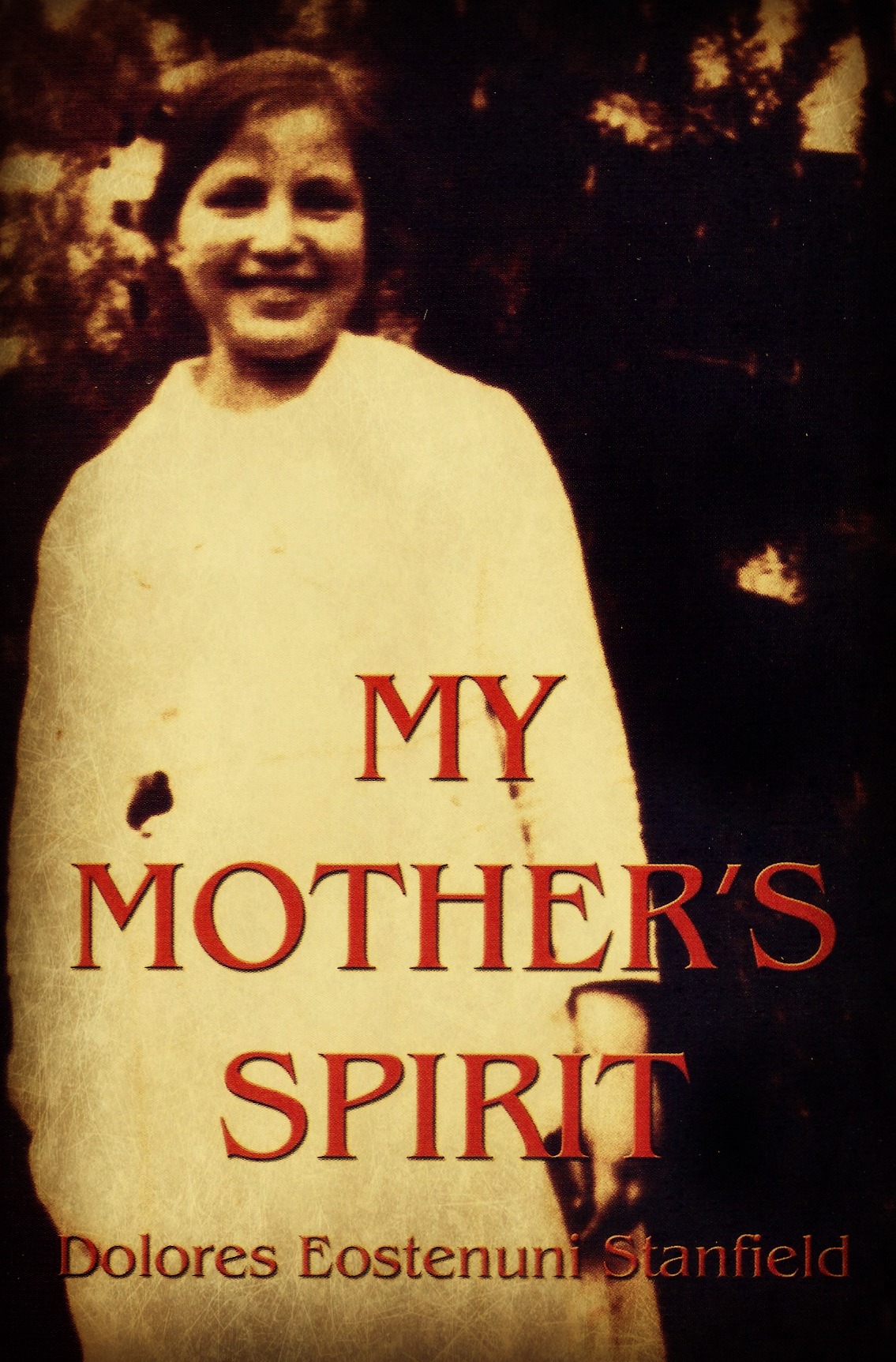
My Mohawk grandmother. This is the cover of the book my mother wrote about her adolescence growing up on the Mohawk reserve. My Mohawk grandmother, Mary Sawatis Jacobs. This is the cover of the book that my mother wrote about growing up on the Mohawk reserve.

“History is a relentless master.  It has no present, only the past rushing into the future. To try to hold fast is to be swept aside.”   — John F. Kennedy

When I was a kid, we’d pile into the station wagon and head to the reservation to visit my mother’s Mohawk side of the family.  My father liked to go there because the men drank beer, fished, and told stories.  My mother liked it, because it was where she felt truly at home.  We kids liked to go because we had lots of cousins, the adults got busy talking, and we were left to look after ourselves. In the summer we swam in the river, and traversed the shoreline, weaving through sweetgrass that smelled like fresh rain.  The cousins taught us how to swear in Mohawk.

There was one church on the entire reservation and it was Catholic.  Father Jacobs was the priest.  He was Mohawk, but also a Catholic priest.  I never questioned this.  The church had a bell tower and a bell rope that hung in the entry.  You could pull that rope down and ride half-way to the ceiling when it was time to ring the bell.

Other than hearing the odd word or phrase spoken in the Mohawk language, or the fact that my male cousins all played Lacrosse, there was not a lot to make the reservation seem much different than the town I was from.  Except that on the reservation, nothing was paved.  There was only dirt and stubby patches of grass. When it rained, people set down planks of wood between their driveway and the door in an effort to keep mud out of the house.  Meals were simple, but hearty.  The items served most often were corn soup and beef hash. Both of which were lovely and delicious and always homemade.  (I guess they also ate a lot of fish, because it was there for the taking, being that the St. Lawrence river wrapped around one side of the reservation, while the St. Regis river cut a swath through the other end.  But I don’t like fish so the recollection of it tends be hazy for me.)

What was missing at that time was festival, ritual, and feathers.  I don’t remember any Native ceremonies or regalia.  There were no sweat lodges.  No pow wows. No moccasin-ed dancing for rain or peace or any other thing.  If we attended church there, it was the same Catholic mass as the one we experienced at home.

The point is, that my comprehension then of what it was like to be Mohawk, to be a Native American living on a reservation, was lacking cultural context.  It was years before I understood why.  I knew that when my mother was growing up, many of her cousins were taken from their homes and placed in an Industrial boarding school in Canada. They were forbidden to speak their native language or participate in native ceremony.  They were there, boys and girls (in separate schools), to be “educated”, which actually meant, to learn to be “white.”

That those schools were often brutal, the quality of education poor, and the food even worse, is well documented.  But Indian schools did more than decimate native cultures, they robbed those children of any value they previously may have thought they had.

Without a culture or a sense of worth, what is left?

My mother’s reservation has come back to their culture slowly, like a long forgotten memory drifting into consciousness once again.  It is not called St. Regis anymore.  We use the Mohawk word instead, Akwesasne.  I love the sound of that.

I began this post on Monday, which was Columbus Day.  In part because of the Daily Post Weekly Writing Challenge, which had as a topic:  Living History.  But mostly because of the day, which my mother cannot let go by without muttering at least once — Columbus, that murdering bastard!

And then I read a piece in the Washington Post which made me wonder again, why do we keep a holiday in honor of a man we now know dealt a brutal hand against the natives of the lands he explored (which wasn’t even America)?  In one of the reader comments, a man asked if there actually were any Indian reservations around these days?  I was about to reply that why, yes, in fact there were many reservations still around, but then I spied another comment a few lines down that wisely pointed out – Do not feed the trolls.  And I realized, of course, it does no good.  You can lead a person to information, but you cannot make them think.

Still.  Can we agree to not honor mean men?  I’d like to believe that history can teach us how to live better.  Kinder.

Maybe one day, we could even get it right.

n.b. The title of this post is a quote taken from a paper read at a convention in 1892 by Richard Henry Pratt, the U.S. Army officer whose brainchild it was to assimilate Indians into a white society.

Alice Falls

Kipling's pond pm~The end of Alice~

The pond was deeper than she expected.  Colder, too.  She felt as though she was sliding, sinking, falling down down down to the bottom — wherever that was.  A sudden flash of memory swam by — Dr. Seuss and McElligott’s Pool.  A kid with a fishing pole and a bottomless pit of water that ends up in an ocean somewhere.

Panic set in as it is wont to do when a person is drowning.  Her mind stopped making sense.  Instead, it fired a final desperate thought: This was how the story ends?  Really?

Bummer.

~Alice’s Parents~

“It’s so quiet without our girl,” her father said.

“It’s quiet because Alice was such a clumsy child, always bumping into things.  A walking, breathing cartoon of ungainly girlhood, she was.  Never had her mind on what she was doing.”

“Not true.  Not true at all”, said Alice’s father. “Alice is a lovely girl.  In another story she might have been a dancer.  We could have called her Clara.”

A slender young man strode into the library.  “Clara?  Who’s Clara?”

“Pay no attention to the old coot,” Alice’s mother replied.  “I haven’t a clue what he’s on about.  He’s a crackpot.”

“Where’s Alice?” the man asked.

“Alice doesn’t live here anymore.  She’s moved.”

Alice’s boyfriend was stunned.

“Can you blame her?” Alice’s father said to his wife.  “You were always at her about something — don’t drink this, don’t eat that, put the key back where you found it – nag, nag, nag.  No wonder she left.”

“Are you saying, it’s my fault?”

“Does a donkey bray?”

The ex-boyfriend turned on his heel and walked out without a word.

The bickering continued.  It never stopped.

~Alice makes up her mind~

Alice had never been able to settle.  No matter where she traveled, how many marvels she discovered, it was never enough, because there was always one irritation that she could not shake.  Herself.

Good, God, she was annoying.  Chasing after some elusive thing.

She knew well enough what she didn’t want: Children; factory work; city living; an overbearing husband (or an even-tempered one for that matter, nope, no husband at all, chalk it up to her parent’s lousy marriage for scaring her off that one).  The list grew longer the older she got.  Her problem was she couldn’t decide what it was she did want.

Until now.

Boxes were still stacked in the foyer of the cottage.  Her cottage.  Her new home. Before she began the task of unpacking, she’d gone to a local market and picked up items for a picnic lunch. Sandwich, chips, some fruit, and a bottle of wine.

It was the pond that sold her.  The water lilies spread like a cape over the surface, fish flicking orange tails just below the surface.  She hadn’t thought of having a pond until she saw this one.  And then, when she did, she knew it’s what she wanted all along.

She had one glass of wine.  That’s all.  Something jumped in the water, and it startled her.  She dropped her glass and it broke, cutting her knuckle.  Then she accidentally knocked over the bottle and the rest of the wine poured out onto the grass as the bottle rolled the few feet and plopped into the pond.

“Dammit.”

She figured she’d kill two birds with one stone.  Retrieve the bottle and wash the blood off her finger at the same time.  She thought about a lot of things in her last few minutes.  Like how much she was going to enjoy living here.  She might even invite her parents for a visit, if they were well enough to make the trip.  Definitely put in a garden around the pond.

She could do anything she wanted now.  After all, she had lots of years ahead of her yet, didn’t she?


~~~~~~~~~~~~~~~~~~~~~~~~~~~~~~~~~~

n.b.  The object of this DP Weekly Writing Challenge was to begin a story with the end.  It sounded like fun.  It was fun to figure out.  I hope you like it.

A clear blue sky

Oh, September . . . you are a hard month.

I hadn’t intended to do a post on 9/11 today.  Though, the fact of the day was on my mind as soon as I woke.  I acknowledged the sadness tied to the date and then checked my email.  There was one from my brother concerning festive plans for the weekend and I engaged myself in thoughts of a happier nature.

Later, while drinking coffee and glancing at the news on the internet, I thought of it again.  I looked at photos of the various commemorations, read some of the comments and anecdotes from people who were there or experienced a near miss.  Their words and the images filled the space I had meant for other things.

I am floored by the enormity of our collective grief. Almost everyone, it seems, knows someone who was directly impacted by that day.

My husband’s cousin and his wife both worked on Wall street.  She worked for Cantor Fitzgerald in the north tower of the World Trade Center, while he was in a building across the street.  The sky was clear and blue on the morning of September 11, 2001, and because it was their first wedding anniversary, they decided to take the day off.

A guy I knew growing up in tiny-town northern New York was voted Most Likely to Succeed when he graduated from high school.  He was a sweet, smart guy with unassuming charm.  Years later his son succeeded in snagging a dream job on Wall Street.  Ironically, also at Cantor Fitzgerald in the north tower.  His name was Shannon Lewis Adams, and he did not have an anniversary to prod him into skipping work that day.

I’ve been in New York City many times in the last twelve years.  But I could not bring myself to make the trip to that painful place in lower Manhattan until last November.  I was stunned by how different it looked.  The makeshift walls surrounding the site, the construction still going on.  I think that it will be beautiful one day.  On that afternoon, though, it felt desolate.  My ears ached from the cold wind that was blowing, but I found what I was looking for.  

I have nothing wise or special to offer up today.  Just a tugging in my heart and a name. The name of a boy I didn’t even know, who was probably sweet and smart and unassuming like his dad.

That is all.

shannon adams

Have you seen my mother?

If you see her, let me know.  There's no money in it for you.  Just knowing you brought me peace of mind is reward enough, right?

I love my mother, but to tell you the truth, I have difficulty keeping track of her.  It’s embarrassing.  Sometimes someone will ask, where’s your mom these days?  To which I often have to answer – I have no idea.  In my defense, she’s a bit of a gad-about.  The Secret Service would be hard-pressed to know where she is all of the time.

For the last several years she has divided her time between a house in Sun Lakes, Arizona, a house in Schenectady, New York, and staying with friends in Akwesasne, the Mohawk reserve that straddles the border of northern New York and Canada, which is where she was born.

For awhile I had four different phone numbers for her on my speed dial, and there have been times when I couldn’t reach her at any of them.  This past spring she sold the Arizona house.  Then my brother took over the Schenectady house, and a couple of weeks ago she settled into a lovely apartment at Akwesasne, on the banks of the St. Lawrence river.  I haven’t heard from or seen her since.

Her schedule is complicated.  On Thursday evenings she goes to someone’s house to play radio Bingo.  Her paramour plays on a horseshoe team and there is always a game going on somewhere.   She is his cheerleader.  Sometimes they have away games.  There are meals out a lot, and until her internet is connected she has to go to the library to check her email.  She has 30 minutes on the library computer and she has a lot of friends.  If there’s a casino nearby she might be there.

Do me a favor and keep an eye out for her:  She is short.  She has nice hair and often wears a ball cap.  (She has a well-shaped head and looks good in caps, which is not a physical trait that she passed on to me.  More’s the pity.) Also, she might be standing on one leg, stork-like, one foot pressed against her thigh.  (She’s taken yoga classes for years, and this pose is good for her balance.  She does it well.  And often.  It must work, because I have never seen her fall over.)

If there is music playing she is apt to be dancing.  (She does a mean jig.)  Or she might be somewhere drinking coffee and staring out a window, deep in thought. She drinks her coffee black, and likes to daydream about solving the problems she thinks her kids have.  (It should be noted that though her kids are middle-age now, in her mind they are still kids.  This may be true for a lot of mothers.)

She answers to various names.  Mom, Mumma, Ista (the Mohawk word for Mother), Tota (pronounced, Du-Da, which means Grandmother in Mohawk), or her given name, Dolores.  Or just whistle.  That works, too.  She is usually friendly and approachable, so don’t be afraid to go right up to her and tell her her daughter is looking for her.  (Unless she thinks you might be trying to sell her something.  Then she will tell you to go to hell.  She is no pushover, my mother.)

If you see her, let me know. There’s no money in it for you, but knowing you   brought me peace of mind is reward enough, right?

Thank you for your help, y’all.  Have a nice day.

P.S.  Here’s your story, Mom.  Now pick up a damn phone and call me.

P.P.S.  I love you.

Beautiful boy

dill 1bThe poesy he smells is so small we can barely see it in his pudgy fist.  (We would have overlooked it — there were so many tiny flowers hidden in the grass that day.)  It is a thing of wonder to him.  As he is a wonder to us all. His curls and creamy skin, his brown eyes kissed by innocence.

See how he clutches his little dog?  What a comfort it is to to him to have it, his reassurance for the times when the world is a scary place to be. (Remember when it was that simple?)

Had you known what the future held, you might have wished to stop time, to freeze that moment forever, because surely there would never be another so perfect.  But then you would have missed the astonishing mystery of him as he grew into a man.  A child so fierce in his conviction that he damn well KNEW when didn’t want to nap, and if you tried to make him he would scream until you got him up.  You would have missed his shyness, his goofiness, his sweet, sweet laughter. His unflinching loyalty to the people he most loved.

Even between the grooves of anxiety and worry that spun the record of your relationship there was still laughter.  Moments of silliness and forgetting.  And love, always love.  A child cries and a parent wants to hold him.  That is the way of life. When that’s gone we grieve not only for our immediate loss, but for what might have been.  We grieve for the potential that will never be fulfilled.

But there is this to keep:  the memory of a sunny day and the single pleasure of watching a child smell a flower just because it’s there.  A child who was then as he will forever be.

A beautiful boy.

n.b.  For my dear, dear friend Andy whose loss I feel and whose pain I share.  And for sweet Dillon.  . . . and flights of angels sing thee to thy rest.

Top 10 reasons I’m glad I married the man I did

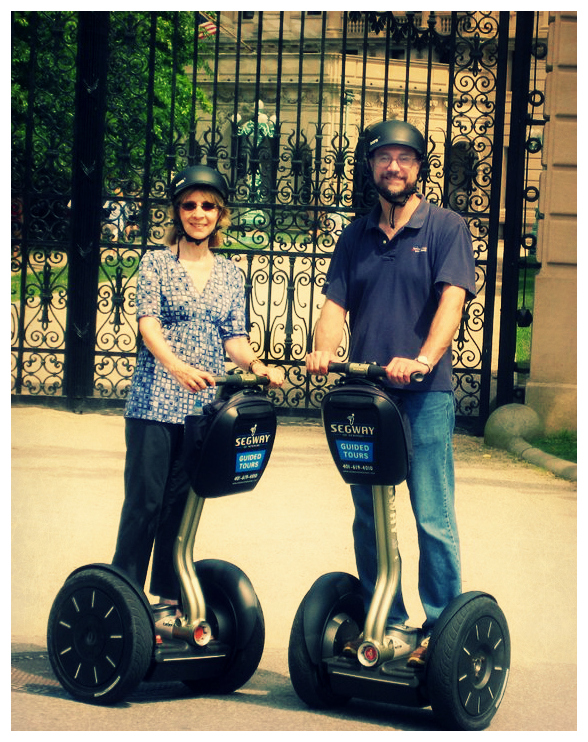
The couple who segway together, stay together.

The couple who segway together, stay together.

It’s my anniversary today (26 years), and because I didn’t get him a card (I’ve been sick and/or traveling a lot), I thought I’d take a page out of Letterman’s entertainment book and list the reasons why I am happy with the choice I made.

10. At our wedding I got to hire a string quartet to play for me us.

9. He truly likes to see romantic movies with me.

8. He can fix pretty near anything I break.

7. He rubs my feet when I ask him.

6. When I call the house phone from bed on weekends, he answers with a smile and says, “Room service.” (And yes, I can hear his smile – that’s how well I know him.)

5. He thinks I’m pretty and tells me often.

4. He’s THE best hugger in the universe.

3. He’s the most honest and trustworthy person I know.

2. He’s a kind and loving father. Which brings me to the number one
reason I’m glad I married the man I did:

1. Our boy. The best of both of us.

The two men in my life I am most grateful for.

The two men in my life I am most grateful for.

Here’s hoping for at least 26 more. I love you, Bob.