Weekly Photo Challenge: Window

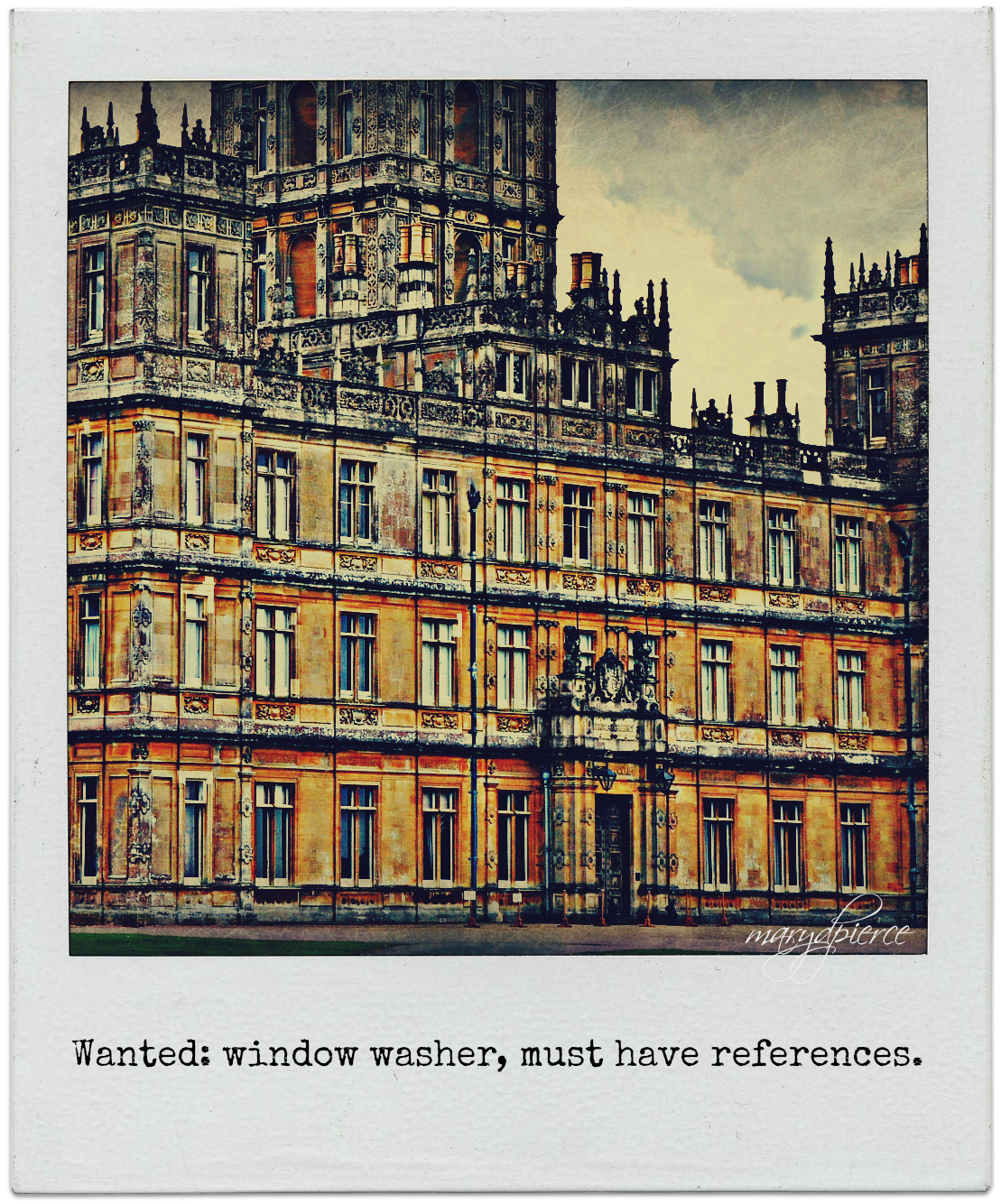
Highclere Castle sig 2

Highclere Castle in Hampshire, UK.   Fellow Downton Abbey fans will recognize it as home to the fictional Crawley family and their gaggle of servants.  I was taken with the breadth of all those windows, lined row upon row like mute sentinels — letting in light, while repelling the elements; offering up views of the world outside, while keeping the viewer out of sight.

What I’d really like to know is, who’s responsible for cleaning them?

Interested in the Weekly Photo Challenge?  Check it out here.

Ring-a-ding-ding

bell pm

Ring out the old, ring in the new
Ring, happy bells, across the snow
The year is going, let him go
Ring out the false, ring in the true.

 Alfred, Lord Tennyson

This was my personal note from The Universe today:

I want you to know, Mary, that I’ve ordered up another year for you.Think I’ll call it 2014.

I’m going to put most of the same people from 2013 in it, since you all think so much alike. But there’ll also be a few new, very cool cats coming to play – give them some time to grow up though.

And I’m going to have things start off pretty much exactly where they left off in 2013, for continuity’s sake. Flips folks out too much when I don’t.

All in all, 365 more days in paradise… and only one request of you:

DREAM BIGGER.

Coolio?

Let’s do this,
The Universe

Dream bigger.  That sounds good to me.  I like that I get my own little note every day from The Universe.  I wake up to them and they always make me smile.  It’s like getting a text from a friend every morning that says, Wake-y, wake-y, you gorgeous creature, you! And you have to believe it, because a friend like that would never lie to you.

Notes from the Universe is just one of the oh-so-many interesting things I discovered through the internet this year.  There are blogs out there, writers who lift me up or break my heart with their words, music–OMG!–the music being played, spoken word poetry, photography, art.  I feel like I spent most of the year in a chair.  Only to discover (on the internet) that sitting too much will make you die.

So it goes.

Last December 31st I blogged about choosing a word for the new year.  One word that I would keep as a source of inspiration, to think on when I needed it. I chose, RISE.  I like how that worked out for me.  This year I’ll take the word DARE along for the ride.

I have big plans for 2014.  There are adventures waiting for me.  After a full and satisfying year of blogging, and discovering kindred spirits, I am going to take a break from all things internet-related in order to write.  Non-stop, seat-of-my-pants, finish-my-damn-book writing.  It’s time.  Look for me in about a month.

Before I go, though, I want to add my voice to the happy throng wishing friends and family well. May 2014 be your best New Year ever.

Cheers and love, people.  Always, the love.

The perfect tree

tree 21013This is not an ordinary Christmas tree.  This tree (though you may not be able to tell at first glance) is perfect.  It is our tree, the one that grew to just the right size and then waited for us to find it.  Every year there is one and only one tree for us, and we always find it, we always do.  And it is perfect.  Every year.

See those little red bows, like the notes of a perfect song, scattered over the branches?  Those bows are from our first Christmas spent in this house, which was newly built with purpose and unfailing energy, and mostly by our own hands.  I made those bows from a fat spool of ribbon and some gold thread that I bought at the Christmas Tree Shops for practically nothing, because we had so little money that year (the house had eaten most of what we had).  And though, they’re hard to pick out in the photo, there are the wicker ornaments, swirled in strands of red and green thread, that we got on our belated Mexican honeymoon just weeks before.

Our life together hangs on that tree.  The Boy’s first dough ornaments; the clay ornaments I made; favorite friends Pikachu and Woody (who still swings his lariat from one of the branches); tiny lockets that hold our Boy’s sweet face with forever smiles at ages two, and five, and seven.  The places we’ve been and the things we’ve seen.  All of them carried home to remember the fun: The Pinocchio and nutcrackers with movable legs; the crowns and the stars and the snowy white owl; a streetcar emblazoned with the year we saw San Francisco.  A clown on a unicycle found in a shop that we’d stepped into to escape the frigid Montreal air.

Our family and our friends, the ones still living, and those who have gone, are there.  In ornaments hand made and store bought, given in love and accepted with gratitude.

Our tree is perfect because it reminds us of what we have and what we’ve shared. When the Boy was small, the bedtime ritual once the tree went up, was to turn off all the lights, save the ones on the tree, and then the three of us sat together and admired the tree.  My husband and I still do this some nights, though the Boy is gone to a place of his own.  We sit sometimes, in the glow of the lights, nostalgic as parents of grown children often are.  And, even in that there is perfection.

We are blessed.

May you all be, as well.

Collecting details: In the bleak midwinter

Observing, collecting details as “glimmers of a beginning.”  A way of finding a story to tell.  That was the challenge this week.

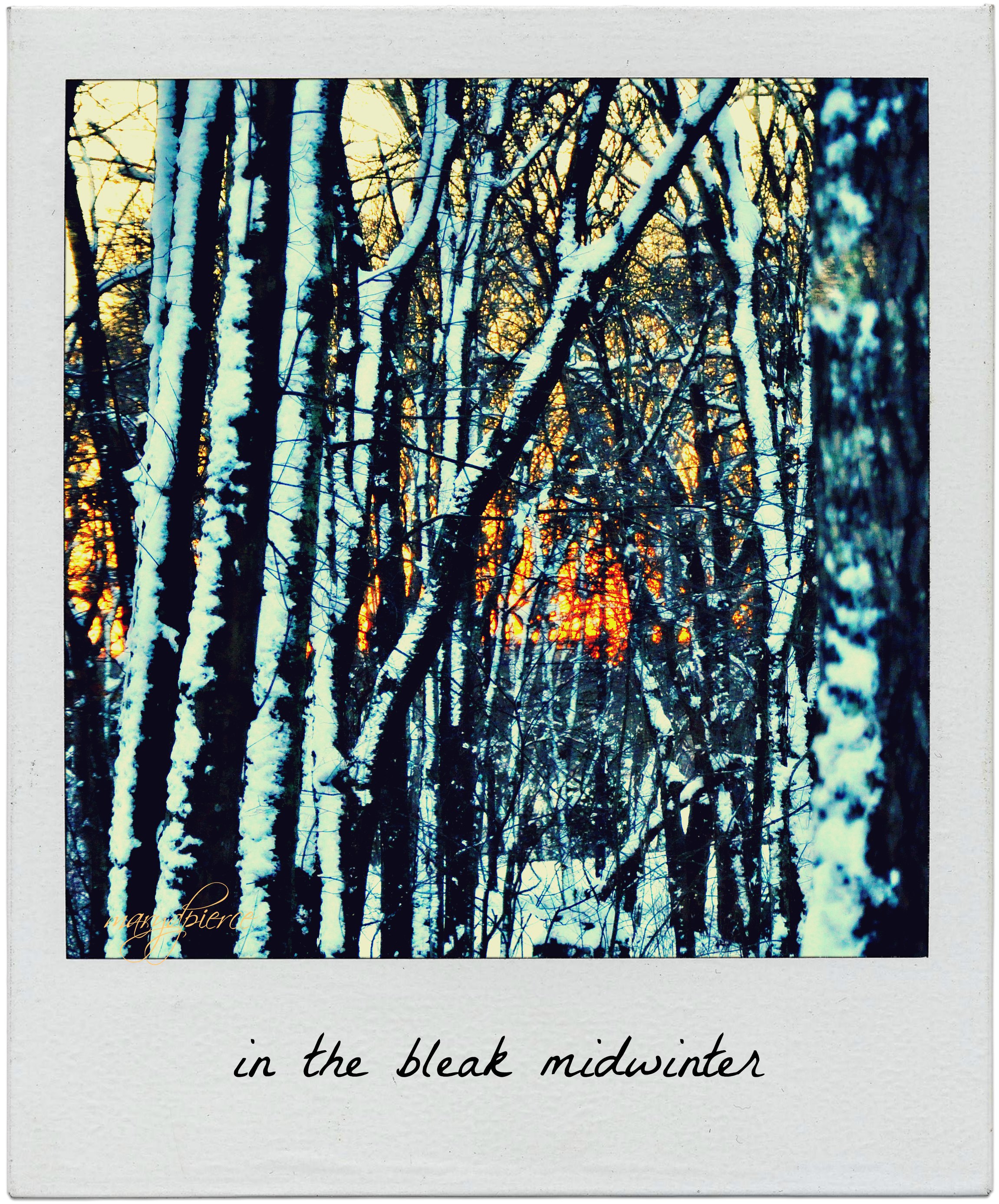
in the bleak midwinter

Somewhere outside my window a machine hums incessantly for the second day in a row.  Its motor drones, the constant whirring sound punctuated by louder grinding noises.  Like a monster being fed, its appetite is ravenous.  It will not be sated.  My husband would be at the window checking to see where the sound is coming from, which neighbor has wood to chip this time of year.  But my husband is at work.  And I am too lazy, too disinterested to check out where Smaug is being used.  It doesn’t really matter in whose yard the machine/monster feeds.  Noise is noise.

Our yard has lots of trees and an overabundance of bittersweet.  The vine sidles up alongside the trees, curling a sinuous path out along limbs, growing thick and woody until it has strangled the life from the tree.  In the green of spring and summer it’s harder to notice the bittersweet in its sneaky trail below a layer of dirt, pushing through shrubs and other plantings.  We hack at it and pull it up, but it is incessant and wears us out.  Now, in the bleak midwinter, it is easy to see.  The vine coils around some of the trees, already thick as rope.

It’s the chill this time of year that I mistrust.  The trees stand like stark centurions behind the house, the only time I can see a sliver of the lake that lay beyond them.  The sky cracks like a sheet of glass.  Fingers feel fat and numb in no time in weather like this.  Why would anyone stand outside and feed wood to a machine?  I imagine how easily a monster like that could steal a finger or two.  There are no do-overs then.

A lawyer I know once defended a man who disposed of his wife with a wood chipper.  The lawyer is a kind man, softly rumpled, with hair just long enough to show a tendency to wave.  He wears sports coats and carries a leather brief case that looks like it was a gift when he graduated law school.  He has a fondness for Mark Twain, and reminds me of Atticus Finch.  I wonder what Atticus would make of a man who rid himself of his wife by such ugly means.  There is no nobility in defending such a person.  I expect the lawyer had his reasons.  He enjoys reading Twain, after all.

Shine a light

Tom with fire.jpg My brother and his trusty Bic lighter.

The boy in the photo above is my brother Tom.  My mother named him Thomas, but we all called him Tommy.  At seventeen he dubbed himself Tomas (pronounced toe-mas, accent on the second syllable).  He took to wearing sunglasses and being quietly mysterious.  It was the first of many personas he would try on for size while looking for how he fit in the world.

It wasn’t easy for him, figuring it out.  He had a handicap from the start: Youngest of seven; born colicky, and needing a lot of soothing in a busy, boisterous family. He was often lost in the fray.

At two he fell through the heating vent in the bedroom floor, bumped accidentally by another brother as they jumped on my parents’ bed.  He landed in the dining room below, barely missing the table. Astonishingly, other than scaring the hell out of us, and knocking the wind out of himself, he was fine.

When he was three, I dumped scalding hot food on him.  Also an accident.  A pressure cooker containing what was meant to be our dinner exploded when I tried to lift the lid.  Tommy was standing by my side.  I was blown backwards, while lava-hot meat and potatoes shot straight up from the pot and rained down on his back.  I can’t remember how long he was in the hospital, but I do remember feeding him ice cream there.  The scars never went away.

After that he managed to make it through the rest of his childhood and adolescence with only the usual bumps and scrapes.  But he was always kind of quiet and a little aloof.  He liked to climb trees where he would sit for hours looking out at the world.  I asked him a few times what he thought about up there, but he wouldn’t tell me.  I think he was dreaming what life could be.

Tommy lived with me three times in my life, beginning when he was Tomas at seventeen.  I lived in Colorado then.  He wanted to finish his last year in high school somewhere other than where he was born.  We joined the local Y and worked out together, ran around the indoor track together, then went for donuts afterwards.  He wore his sunglasses and skipped classes and shared falafel with the homeless guys who hung out in the park.  At the end of the year he went back to my mother.

The next time he came to live with me I had just moved to Rhode Island.  He slept in my basement and got a job as a cook in a nursing home within walking distance of my apartment.  Eventually he met someone, and moved in with her.  He got a job at Electric Boat and learned how to weld the seams of atomic submarines.  In his down time he helped my husband and I build our house.

He had a baby with the woman he lived with, a boy who looked a lot like him.  He took photos and put them in an album where he wrote things like from father to son and, a man with song and dance not to mention poise across the pages. Then the woman took the baby out of state and had Tom sign a paper relinquishing his paternal rights.  He signed it because “it was what she wanted”, but it broke his heart to do so.  He never saw his son again.

He tried to fill the hole by being a fabulous uncle to his nephews.  He took them for walks and held their hands and watched cartoons with them.  He listened to their dreams and understood.

The last time Tom lived with me his life had begun to unravel.  By then he’d been diagnosed with a disease that would increasingly stiffen his spine and cause him pain.  A few days after he moved in with us, he simply stopped going to work.  He was tired of smacking his head on the insides of the submarines he was welding.

When I turned 35 Tom told me that I was old, being just 5 years from 40, as though 40 was near to the end of it all.  He must have believed that, since he took himself out of the equation at 33.  I’ve written about that choice in a more oblique form elsewhere on this blog.

Today is Tommy’s birthday.  By his thinking he would be old.  To the rest of my siblings–Amy, Kathy, Jaime, S.K.–and myself, he is still and will always be the youngest, the most fragile of us all who, nevertheless, keeps us buoyed and connected to one another by the memory of his life.

Happy Birthday, little brother.  Tonight the light in my window shines for you.

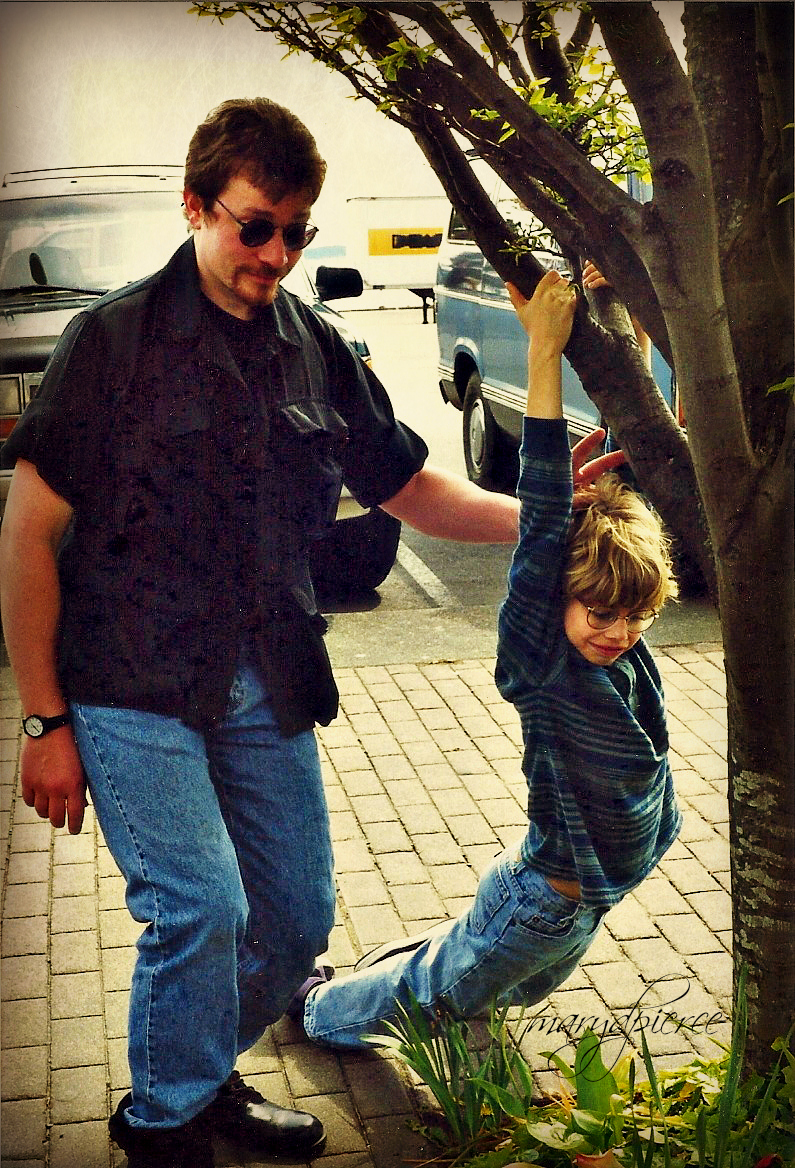
Uncle Tommy with my the Boy, taken two weeks before he left us on our own. Uncle Tommy with my Boy, taken two weeks before he died.

While my heart gently sings

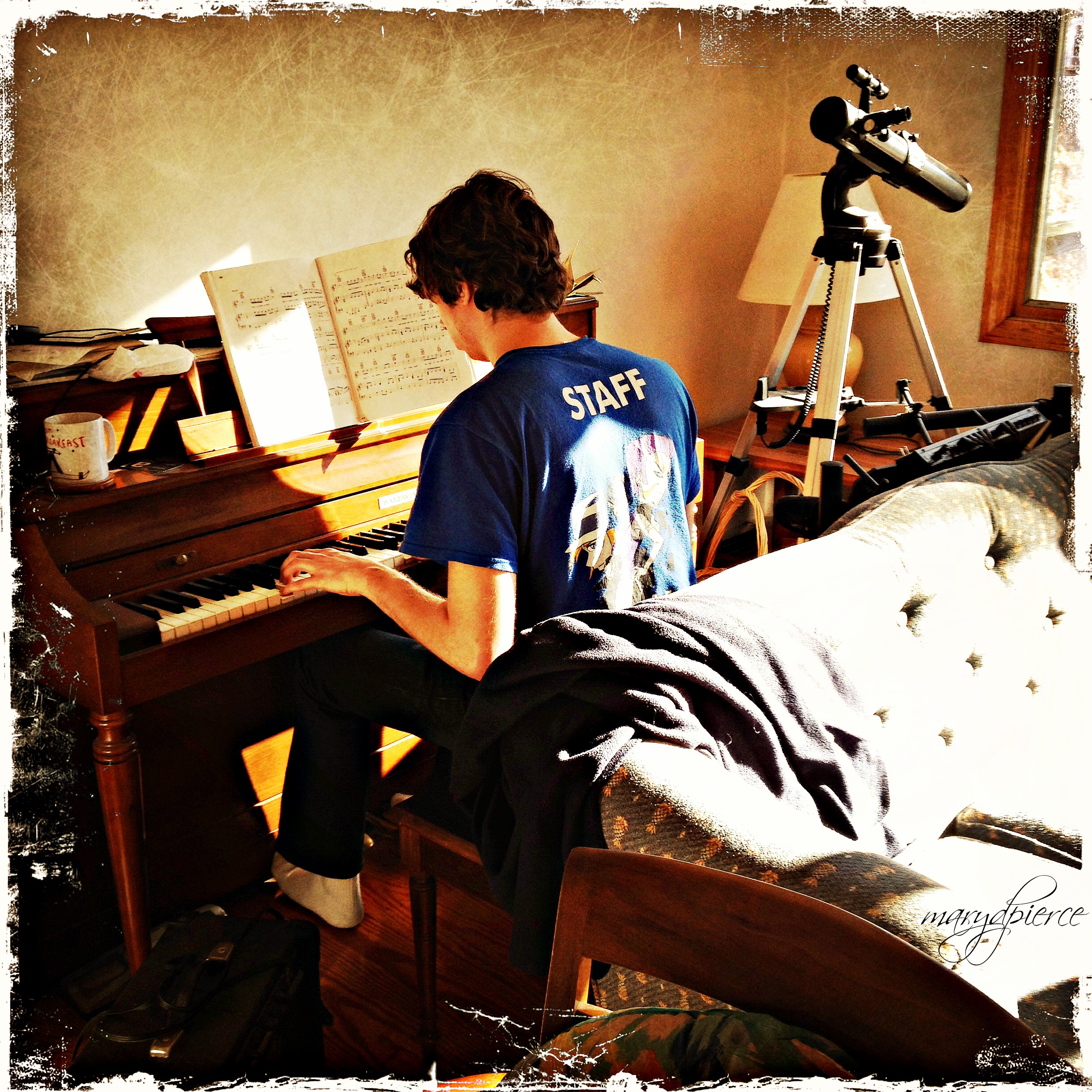
The Boy is home.  Which is, in itself, a joyous event, but he is also playing the piano in the den.  The sun is bright, near-white from the frigid air outside, but slanting through the window it brings in only warmth that spills across the room. The music rides the sun’s coattails and radiates through the entire house.

What more could one wish for in life than this?

The boy plays, my heart sings. . . .

The Boy plays, and my heart sings. . . .

We are all contributing to the meal today.  My husband is doing the mashed potatoes because no one mashes potatoes like him.  The Boy is giving us his version of mac-n-cheese.  I’m doing the roast and the vegetables.  I’ve made brownies for dessert, extra dark and extra fudgey.   It’s all about easy-peasy today.  And togetherness.

There are no pilgrim hats or cornucopias overflowing with fruit on our table.  I didn’t make a pie.  We are a small group, the three of us, and we are not big eaters.  This year we’re shooting for something more intangible than mountains of food.  Something to fill our spirits rather than our bellies (though our bellies will do well enough). The cherry on the top of our day will be when we settle in to our comfy living room later and listen while the Boy reads aloud the last 50 or so pages of Fahrenheit 451 because I haven’t managed to finish reading it yet, and it’s time.  It is most definitely time.

Oh, that we were all wealthy in love and good will.  That everyone could be kind.  For the wonderful people I am blessed to love and care about (and there are a LOT of you out there) I wish you all that and more.  I wish you peace and gratitude wherever you may be.  Here’s to filling your souls to overflowing.

Because it’s time.

Cleaning house

As I am wont to do periodically, I have gone quiet.  The truth is, that sometimes the world is too much with me.  This is a time when I hunker down, take stock, recharge, rethink, re-plan.  It used to worry me, these periods of introspection. Now we know so much more about things like depression and how introverts function, and I have learned to ride it out.

One of the things I’ve been thinking about, is that it’s time to clean out my house. And not just metaphorically.  After twenty-six years living with the same man in the same house, we have accumulated a lot of stuff.  After a while the stuff gets in my way.

I’m focusing first on my studio.  The room that houses most of my books and all my art supplies.  (I’d include a photo, except that it would embarrass me to no end to have you see how neglectful I’ve been — my family knows what I’m talking about, ask them.)  It’s also the room where I exercise, write and do all my creative work, the room where my muse resides. She is not happy with the mess.

I’m on a mission here:  Pay heed to my muse and get rid of a lot of stuff.  So, if you haven’t heard from me in awhile, this is where I’m at.

I’ll be back momentarily.  I promise.  In the meantime, I’ll leave you with this little tidbit.  Something I found in one of the many notebooks I have scattered around the room like old shoes.  I rarely date things, so I have no idea when I wrote this, nor do I remember what its purpose was, other than that I do have reoccurring dreams of flying.

Enjoy.

In dreams, I fly, though there are no wings budding from my back like tender shoots that blossom on spring trees.  No feathers fanning in orgasmic waves behind me. There are just my arms — flesh and blood and bone — to lift me, weightless as a dime while I circle above my oldest fears, childhood tormentors grown fat, and unrecognizable, wearing clown pants and floppy shoes.

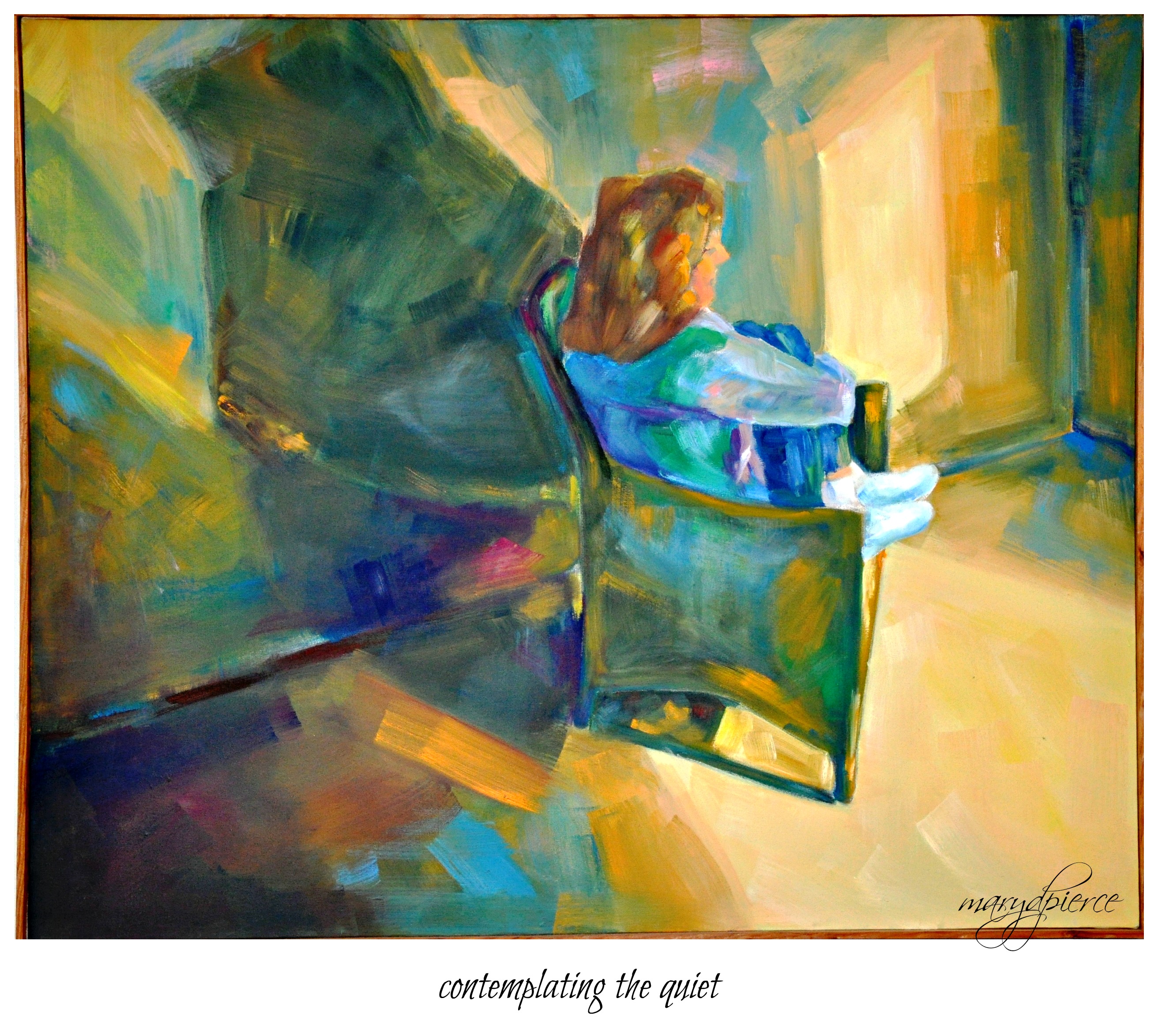
Being quiet pm

And this . . . painted while I was in college and my house had hardly any stuff at all.

“Kill the Indian, and save the man.”

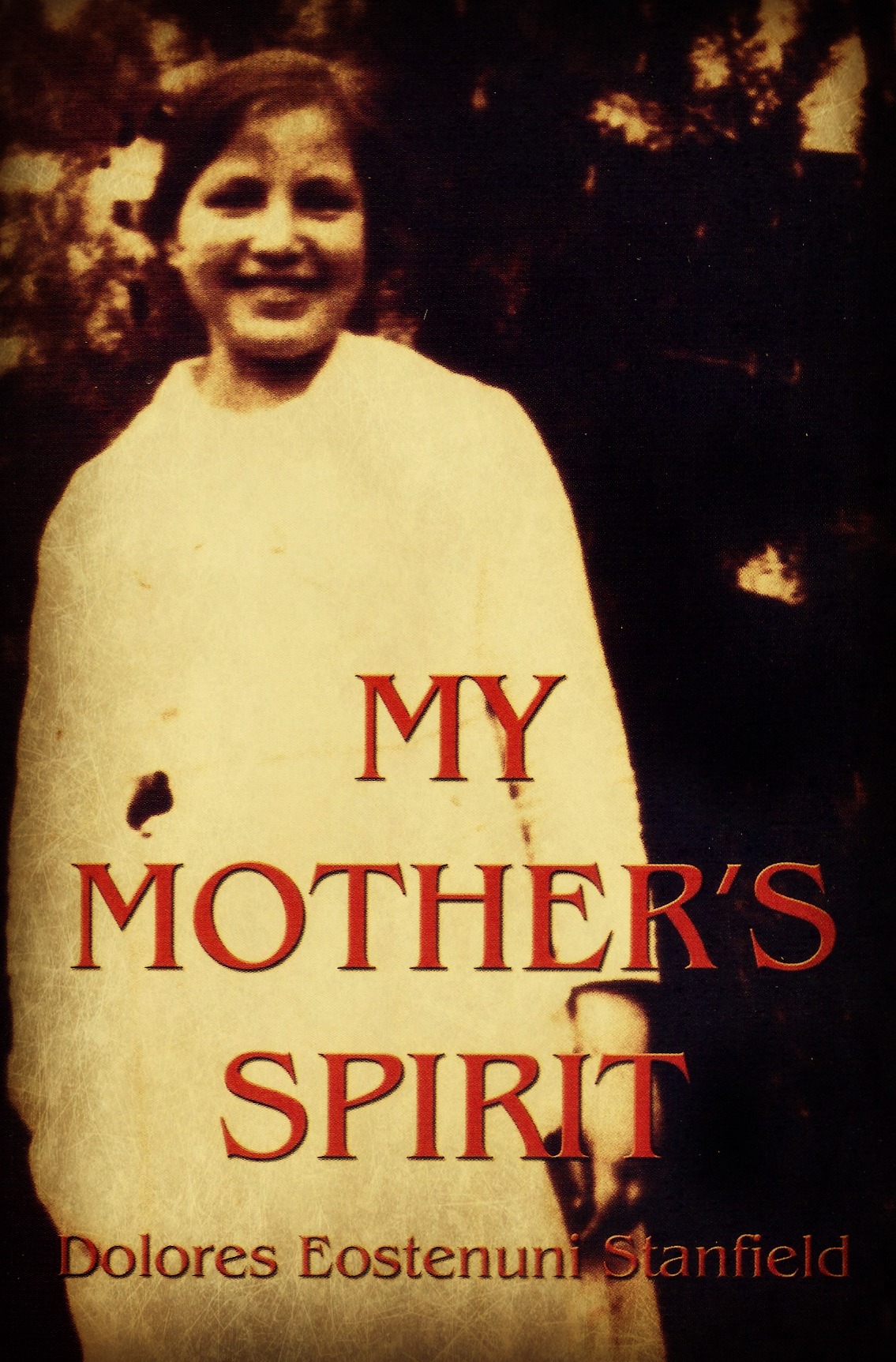
My Mohawk grandmother. This is the cover of the book my mother wrote about her adolescence growing up on the Mohawk reserve. My Mohawk grandmother, Mary Sawatis Jacobs. This is the cover of the book that my mother wrote about growing up on the Mohawk reserve.

“History is a relentless master.  It has no present, only the past rushing into the future. To try to hold fast is to be swept aside.”   — John F. Kennedy

When I was a kid, we’d pile into the station wagon and head to the reservation to visit my mother’s Mohawk side of the family.  My father liked to go there because the men drank beer, fished, and told stories.  My mother liked it, because it was where she felt truly at home.  We kids liked to go because we had lots of cousins, the adults got busy talking, and we were left to look after ourselves. In the summer we swam in the river, and traversed the shoreline, weaving through sweetgrass that smelled like fresh rain.  The cousins taught us how to swear in Mohawk.

There was one church on the entire reservation and it was Catholic.  Father Jacobs was the priest.  He was Mohawk, but also a Catholic priest.  I never questioned this.  The church had a bell tower and a bell rope that hung in the entry.  You could pull that rope down and ride half-way to the ceiling when it was time to ring the bell.

Other than hearing the odd word or phrase spoken in the Mohawk language, or the fact that my male cousins all played Lacrosse, there was not a lot to make the reservation seem much different than the town I was from.  Except that on the reservation, nothing was paved.  There was only dirt and stubby patches of grass. When it rained, people set down planks of wood between their driveway and the door in an effort to keep mud out of the house.  Meals were simple, but hearty.  The items served most often were corn soup and beef hash. Both of which were lovely and delicious and always homemade.  (I guess they also ate a lot of fish, because it was there for the taking, being that the St. Lawrence river wrapped around one side of the reservation, while the St. Regis river cut a swath through the other end.  But I don’t like fish so the recollection of it tends be hazy for me.)

What was missing at that time was festival, ritual, and feathers.  I don’t remember any Native ceremonies or regalia.  There were no sweat lodges.  No pow wows. No moccasin-ed dancing for rain or peace or any other thing.  If we attended church there, it was the same Catholic mass as the one we experienced at home.

The point is, that my comprehension then of what it was like to be Mohawk, to be a Native American living on a reservation, was lacking cultural context.  It was years before I understood why.  I knew that when my mother was growing up, many of her cousins were taken from their homes and placed in an Industrial boarding school in Canada. They were forbidden to speak their native language or participate in native ceremony.  They were there, boys and girls (in separate schools), to be “educated”, which actually meant, to learn to be “white.”

That those schools were often brutal, the quality of education poor, and the food even worse, is well documented.  But Indian schools did more than decimate native cultures, they robbed those children of any value they previously may have thought they had.

Without a culture or a sense of worth, what is left?

My mother’s reservation has come back to their culture slowly, like a long forgotten memory drifting into consciousness once again.  It is not called St. Regis anymore.  We use the Mohawk word instead, Akwesasne.  I love the sound of that.

I began this post on Monday, which was Columbus Day.  In part because of the Daily Post Weekly Writing Challenge, which had as a topic:  Living History.  But mostly because of the day, which my mother cannot let go by without muttering at least once — Columbus, that murdering bastard!

And then I read a piece in the Washington Post which made me wonder again, why do we keep a holiday in honor of a man we now know dealt a brutal hand against the natives of the lands he explored (which wasn’t even America)?  In one of the reader comments, a man asked if there actually were any Indian reservations around these days?  I was about to reply that why, yes, in fact there were many reservations still around, but then I spied another comment a few lines down that wisely pointed out – Do not feed the trolls.  And I realized, of course, it does no good.  You can lead a person to information, but you cannot make them think.

Still.  Can we agree to not honor mean men?  I’d like to believe that history can teach us how to live better.  Kinder.

Maybe one day, we could even get it right.

n.b. The title of this post is a quote taken from a paper read at a convention in 1892 by Richard Henry Pratt, the U.S. Army officer whose brainchild it was to assimilate Indians into a white society.

Who do I think I am?

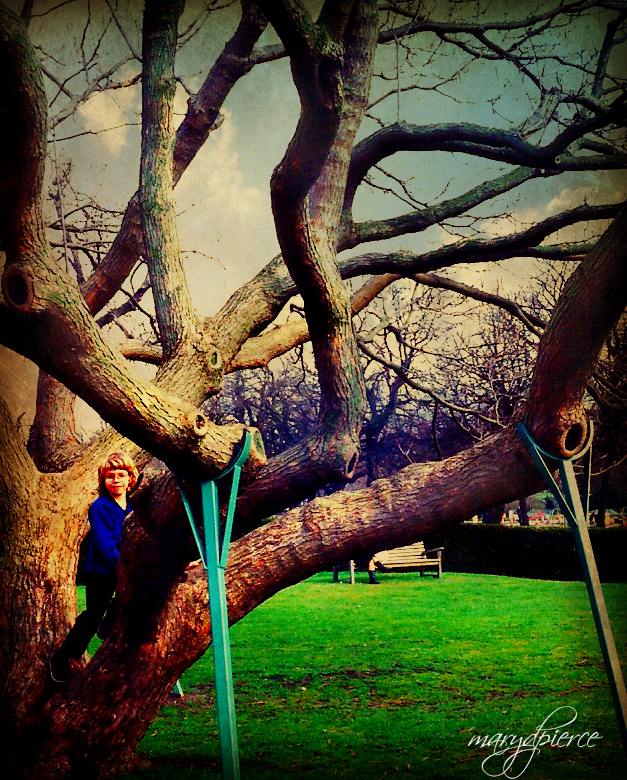
Like my Family Tree - old, propped up, but still growing strong.

Like my Family Tree – old, propped up, but still growing strong.

My maternal grandmother was full-blooded Mohawk and a devout Catholic.  She wanted to be a nun.  On her way to that vocation she met my grandfather, a tall, handsome white man who was also a state trooper trying to catch her mother in the act of selling whiskey.  It was Prohibition, and Agnes, my great-grandmother owned a speakeasy.  My grandparents fell in love, got married, and my grandfather gave up being a trooper to join his new mother-in-law’s business.  Not exactly a propitious union.  Nevertheless, it produced three daughters.  Only my mother, the youngest, survived childhood.  I was named Mary for that grandmother, though I never got to meet her.  She died when my mother was three.

My paternal grandmother went without a name for weeks after she was born.  My great-grandmother, having recently lost an infant son, wanted to wait and see if this baby survived before handing out a name.  Finally, one of great-grandma’s sisters looked down at my poor, swaddled grandmother and said she looked like a little pearl.  And that’s the name they slapped on the birth certificate.  No middle name, just Pearl and her surname, which was Crawford.  It embarrassed my grandmother, not having a middle name.  When she married she began using the initial from her surname as part of her signature, to legitimize the oddball she always felt she was, as though just the initial of a pretend middle name would make her just like everyone else.  It didn’t, and she wasn’t.  And that was okay by me.

I’ve never looked farther than three generations behind me.  I know nothing besides a handful of family stories that may or may not be true.  I might be related to Franklin Pierce, 14th President of the United Sates.  I might be related to Daniel Webster, statesman and Massachusetts senator.  There might still be a castle in England somewhere with a Stanfield still living in it.  I don’t have a pedigree to tout.  I know that among the generations whose lives I’ve been told something about, most came from England, Scotland, Ireland, and one at least, from France.  Or, like my namesake grandmother’s side of the family, they were already here.

I think a lot about family, about where I come from, and who I am.  When I was about seven or eight, I would stare in a mirror and experience a complete disconnect with the image looking back at me.  Who was that person, I used to wonder?  The face, the stuff behind the face?  Was I real?  I had no clue. (What a strange child I must have been.) When I got a little older I searched the faces of my parents and siblings for  family resemblances, something that would make me feel like I belonged, but  there was such a grab-bag selection of this nose with that jaw and those teeth or eyes, hairlines, cheekbones, hand and foot size that not one of us looked much like the other.  (Later my siblings and I would joke about the possibility of a milkman or two being thrown into the mix.  Except that we bought our milk at the store.)  It still amazes me when I run across families whose members look so remarkably alike that there’s never any question of relatedness.

Like my grandmother, I have also felt like an oddball.  Within my immediate family I used to think I could have been a changeling left on the doorstep by trolls. The feeling has abated somewhat in recent years.  But, sometimes I still feel a little out of sync with the people around me.  What I’m passionate about, what I think about, what I like and don’t like, what I dream.

And I think about the list of ingredients that went into the soup that made me:

A grandmother who thought she’d be wedded to Christ, but chose marriage to another man instead.  She left behind a daughter who was raised by so many other people it took her eighty years to find a place where she feels like she belongs.

Another grandmother who, for want of a middle name, thought herself so much less than she actually was.

Bootleggers, gamblers, drinkers, farmers, a failed blacksmith who played the fiddle, house painters, steel workers, bookworms, librarians – dreamers, all.

And something else.  I look back and see more than just the sum of what they did with their lives.  I look back and see qualities like tenacity, hope, and a desire to be better and farther than from where they began.  All those things are good in soup.

DNA is like a magic show.  I know that sleight of hand is involved, that the trick isn’t really magic, and sometimes I even know how the trick is done.  But it’s still strange and thrilling to observe.  How do geese know to fly south?  How did they know that there was a “south” in the first place?  There are all these questions I have.  In my next life, I think that I’ll study genetics.

Or maybe I’ll just learn to sing.

This post brought to you by the DP Weekly Writing Challenge.