The perfect tree

tree 21013This is not an ordinary Christmas tree.  This tree (though you may not be able to tell at first glance) is perfect.  It is our tree, the one that grew to just the right size and then waited for us to find it.  Every year there is one and only one tree for us, and we always find it, we always do.  And it is perfect.  Every year.

See those little red bows, like the notes of a perfect song, scattered over the branches?  Those bows are from our first Christmas spent in this house, which was newly built with purpose and unfailing energy, and mostly by our own hands.  I made those bows from a fat spool of ribbon and some gold thread that I bought at the Christmas Tree Shops for practically nothing, because we had so little money that year (the house had eaten most of what we had).  And though, they’re hard to pick out in the photo, there are the wicker ornaments, swirled in strands of red and green thread, that we got on our belated Mexican honeymoon just weeks before.

Our life together hangs on that tree.  The Boy’s first dough ornaments; the clay ornaments I made; favorite friends Pikachu and Woody (who still swings his lariat from one of the branches); tiny lockets that hold our Boy’s sweet face with forever smiles at ages two, and five, and seven.  The places we’ve been and the things we’ve seen.  All of them carried home to remember the fun: The Pinocchio and nutcrackers with movable legs; the crowns and the stars and the snowy white owl; a streetcar emblazoned with the year we saw San Francisco.  A clown on a unicycle found in a shop that we’d stepped into to escape the frigid Montreal air.

Our family and our friends, the ones still living, and those who have gone, are there.  In ornaments hand made and store bought, given in love and accepted with gratitude.

Our tree is perfect because it reminds us of what we have and what we’ve shared. When the Boy was small, the bedtime ritual once the tree went up, was to turn off all the lights, save the ones on the tree, and then the three of us sat together and admired the tree.  My husband and I still do this some nights, though the Boy is gone to a place of his own.  We sit sometimes, in the glow of the lights, nostalgic as parents of grown children often are.  And, even in that there is perfection.

We are blessed.

May you all be, as well.
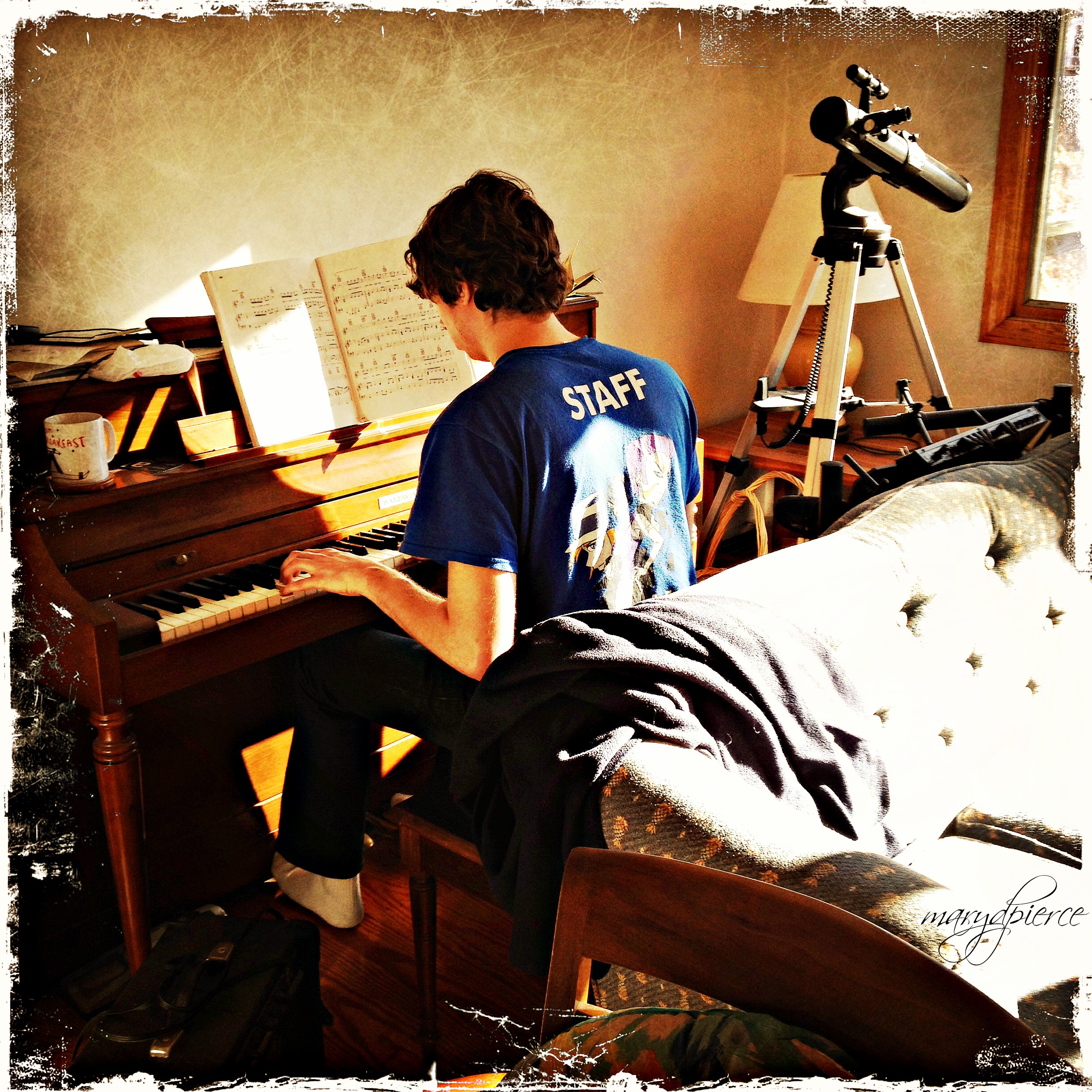
While my heart gently sings

The Boy is home.  Which is, in itself, a joyous event, but he is also playing the piano in the den.  The sun is bright, near-white from the frigid air outside, but slanting through the window it brings in only warmth that spills across the room. The music rides the sun’s coattails and radiates through the entire house.

What more could one wish for in life than this?

The boy plays, my heart sings. . . .

The Boy plays, and my heart sings. . . .

We are all contributing to the meal today.  My husband is doing the mashed potatoes because no one mashes potatoes like him.  The Boy is giving us his version of mac-n-cheese.  I’m doing the roast and the vegetables.  I’ve made brownies for dessert, extra dark and extra fudgey.   It’s all about easy-peasy today.  And togetherness.

There are no pilgrim hats or cornucopias overflowing with fruit on our table.  I didn’t make a pie.  We are a small group, the three of us, and we are not big eaters.  This year we’re shooting for something more intangible than mountains of food.  Something to fill our spirits rather than our bellies (though our bellies will do well enough). The cherry on the top of our day will be when we settle in to our comfy living room later and listen while the Boy reads aloud the last 50 or so pages of Fahrenheit 451 because I haven’t managed to finish reading it yet, and it’s time.  It is most definitely time.

Oh, that we were all wealthy in love and good will.  That everyone could be kind.  For the wonderful people I am blessed to love and care about (and there are a LOT of you out there) I wish you all that and more.  I wish you peace and gratitude wherever you may be.  Here’s to filling your souls to overflowing.

Because it’s time.

“Kill the Indian, and save the man.”

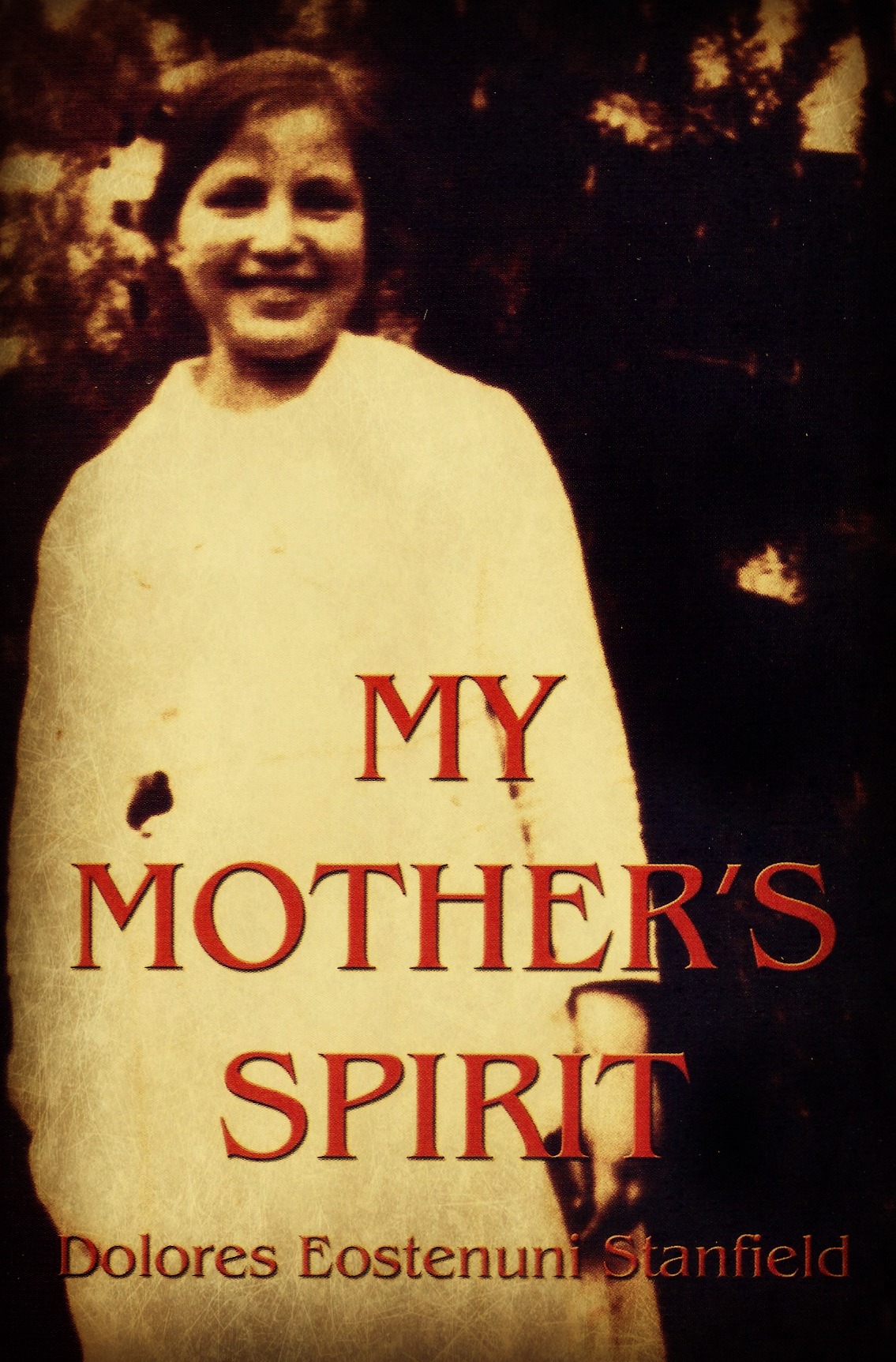
My Mohawk grandmother. This is the cover of the book my mother wrote about her adolescence growing up on the Mohawk reserve. My Mohawk grandmother, Mary Sawatis Jacobs. This is the cover of the book that my mother wrote about growing up on the Mohawk reserve.

“History is a relentless master.  It has no present, only the past rushing into the future. To try to hold fast is to be swept aside.”   — John F. Kennedy

When I was a kid, we’d pile into the station wagon and head to the reservation to visit my mother’s Mohawk side of the family.  My father liked to go there because the men drank beer, fished, and told stories.  My mother liked it, because it was where she felt truly at home.  We kids liked to go because we had lots of cousins, the adults got busy talking, and we were left to look after ourselves. In the summer we swam in the river, and traversed the shoreline, weaving through sweetgrass that smelled like fresh rain.  The cousins taught us how to swear in Mohawk.

There was one church on the entire reservation and it was Catholic.  Father Jacobs was the priest.  He was Mohawk, but also a Catholic priest.  I never questioned this.  The church had a bell tower and a bell rope that hung in the entry.  You could pull that rope down and ride half-way to the ceiling when it was time to ring the bell.

Other than hearing the odd word or phrase spoken in the Mohawk language, or the fact that my male cousins all played Lacrosse, there was not a lot to make the reservation seem much different than the town I was from.  Except that on the reservation, nothing was paved.  There was only dirt and stubby patches of grass. When it rained, people set down planks of wood between their driveway and the door in an effort to keep mud out of the house.  Meals were simple, but hearty.  The items served most often were corn soup and beef hash. Both of which were lovely and delicious and always homemade.  (I guess they also ate a lot of fish, because it was there for the taking, being that the St. Lawrence river wrapped around one side of the reservation, while the St. Regis river cut a swath through the other end.  But I don’t like fish so the recollection of it tends be hazy for me.)

What was missing at that time was festival, ritual, and feathers.  I don’t remember any Native ceremonies or regalia.  There were no sweat lodges.  No pow wows. No moccasin-ed dancing for rain or peace or any other thing.  If we attended church there, it was the same Catholic mass as the one we experienced at home.

The point is, that my comprehension then of what it was like to be Mohawk, to be a Native American living on a reservation, was lacking cultural context.  It was years before I understood why.  I knew that when my mother was growing up, many of her cousins were taken from their homes and placed in an Industrial boarding school in Canada. They were forbidden to speak their native language or participate in native ceremony.  They were there, boys and girls (in separate schools), to be “educated”, which actually meant, to learn to be “white.”

That those schools were often brutal, the quality of education poor, and the food even worse, is well documented.  But Indian schools did more than decimate native cultures, they robbed those children of any value they previously may have thought they had.

Without a culture or a sense of worth, what is left?

My mother’s reservation has come back to their culture slowly, like a long forgotten memory drifting into consciousness once again.  It is not called St. Regis anymore.  We use the Mohawk word instead, Akwesasne.  I love the sound of that.

I began this post on Monday, which was Columbus Day.  In part because of the Daily Post Weekly Writing Challenge, which had as a topic:  Living History.  But mostly because of the day, which my mother cannot let go by without muttering at least once — Columbus, that murdering bastard!

And then I read a piece in the Washington Post which made me wonder again, why do we keep a holiday in honor of a man we now know dealt a brutal hand against the natives of the lands he explored (which wasn’t even America)?  In one of the reader comments, a man asked if there actually were any Indian reservations around these days?  I was about to reply that why, yes, in fact there were many reservations still around, but then I spied another comment a few lines down that wisely pointed out – Do not feed the trolls.  And I realized, of course, it does no good.  You can lead a person to information, but you cannot make them think.

Still.  Can we agree to not honor mean men?  I’d like to believe that history can teach us how to live better.  Kinder.

Maybe one day, we could even get it right.

n.b. The title of this post is a quote taken from a paper read at a convention in 1892 by Richard Henry Pratt, the U.S. Army officer whose brainchild it was to assimilate Indians into a white society.

A clear blue sky

Oh, September . . . you are a hard month.

I hadn’t intended to do a post on 9/11 today.  Though, the fact of the day was on my mind as soon as I woke.  I acknowledged the sadness tied to the date and then checked my email.  There was one from my brother concerning festive plans for the weekend and I engaged myself in thoughts of a happier nature.

Later, while drinking coffee and glancing at the news on the internet, I thought of it again.  I looked at photos of the various commemorations, read some of the comments and anecdotes from people who were there or experienced a near miss.  Their words and the images filled the space I had meant for other things.

I am floored by the enormity of our collective grief. Almost everyone, it seems, knows someone who was directly impacted by that day.

My husband’s cousin and his wife both worked on Wall street.  She worked for Cantor Fitzgerald in the north tower of the World Trade Center, while he was in a building across the street.  The sky was clear and blue on the morning of September 11, 2001, and because it was their first wedding anniversary, they decided to take the day off.

A guy I knew growing up in tiny-town northern New York was voted Most Likely to Succeed when he graduated from high school.  He was a sweet, smart guy with unassuming charm.  Years later his son succeeded in snagging a dream job on Wall Street.  Ironically, also at Cantor Fitzgerald in the north tower.  His name was Shannon Lewis Adams, and he did not have an anniversary to prod him into skipping work that day.

I’ve been in New York City many times in the last twelve years.  But I could not bring myself to make the trip to that painful place in lower Manhattan until last November.  I was stunned by how different it looked.  The makeshift walls surrounding the site, the construction still going on.  I think that it will be beautiful one day.  On that afternoon, though, it felt desolate.  My ears ached from the cold wind that was blowing, but I found what I was looking for.  

I have nothing wise or special to offer up today.  Just a tugging in my heart and a name. The name of a boy I didn’t even know, who was probably sweet and smart and unassuming like his dad.

That is all.

shannon adams

Beautiful boy

dill 1bThe poesy he smells is so small we can barely see it in his pudgy fist.  (We would have overlooked it — there were so many tiny flowers hidden in the grass that day.)  It is a thing of wonder to him.  As he is a wonder to us all. His curls and creamy skin, his brown eyes kissed by innocence.

See how he clutches his little dog?  What a comfort it is to to him to have it, his reassurance for the times when the world is a scary place to be. (Remember when it was that simple?)

Had you known what the future held, you might have wished to stop time, to freeze that moment forever, because surely there would never be another so perfect.  But then you would have missed the astonishing mystery of him as he grew into a man.  A child so fierce in his conviction that he damn well KNEW when didn’t want to nap, and if you tried to make him he would scream until you got him up.  You would have missed his shyness, his goofiness, his sweet, sweet laughter. His unflinching loyalty to the people he most loved.

Even between the grooves of anxiety and worry that spun the record of your relationship there was still laughter.  Moments of silliness and forgetting.  And love, always love.  A child cries and a parent wants to hold him.  That is the way of life. When that’s gone we grieve not only for our immediate loss, but for what might have been.  We grieve for the potential that will never be fulfilled.

But there is this to keep:  the memory of a sunny day and the single pleasure of watching a child smell a flower just because it’s there.  A child who was then as he will forever be.

A beautiful boy.

n.b.  For my dear, dear friend Andy whose loss I feel and whose pain I share.  And for sweet Dillon.  . . . and flights of angels sing thee to thy rest.

Top 10 reasons I’m glad I married the man I did

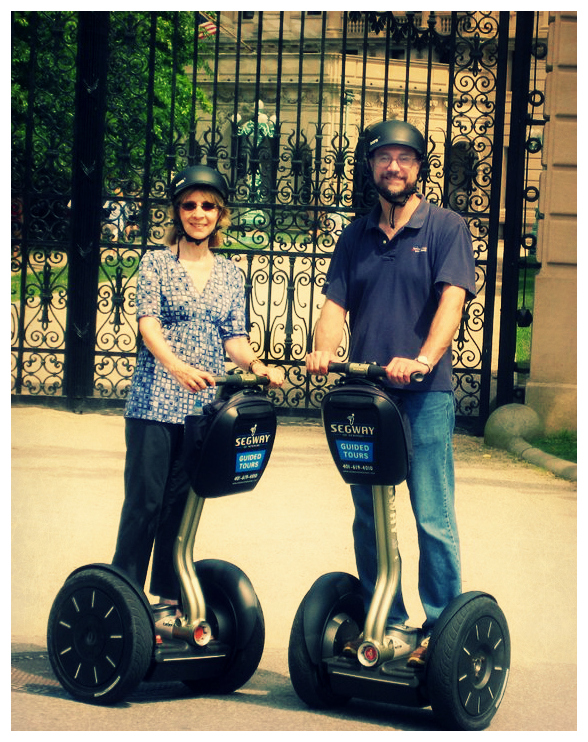
The couple who segway together, stay together.

The couple who segway together, stay together.

It’s my anniversary today (26 years), and because I didn’t get him a card (I’ve been sick and/or traveling a lot), I thought I’d take a page out of Letterman’s entertainment book and list the reasons why I am happy with the choice I made.

10. At our wedding I got to hire a string quartet to play for me us.

9. He truly likes to see romantic movies with me.

8. He can fix pretty near anything I break.

7. He rubs my feet when I ask him.

6. When I call the house phone from bed on weekends, he answers with a smile and says, “Room service.” (And yes, I can hear his smile – that’s how well I know him.)

5. He thinks I’m pretty and tells me often.

4. He’s THE best hugger in the universe.

3. He’s the most honest and trustworthy person I know.

2. He’s a kind and loving father. Which brings me to the number one
reason I’m glad I married the man I did:

1. Our boy. The best of both of us.

The two men in my life I am most grateful for.

The two men in my life I am most grateful for.

Here’s hoping for at least 26 more. I love you, Bob.

An imperfect man

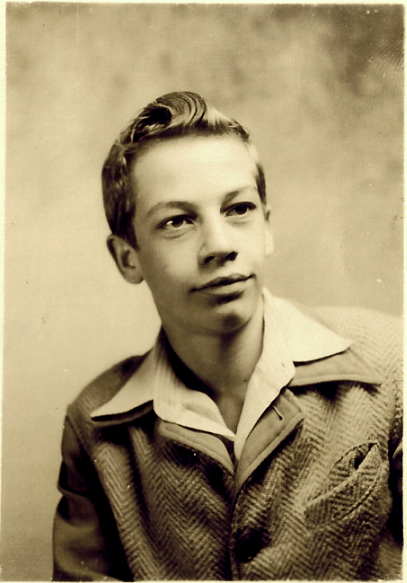
My Dad as a teenager. Even then, a sharp-dressed man. My Dad as a teenager. Even then, a sharp-dressed man.

My father is a nutball.  He cannot pass a tea shop without buying bags of loose tea.  Even though he has enough already squirreled away at home to last him into the NEXT millennium.  He buys clothes for the same reason the Kardashians do — because he loves a snappy outfit.  Unlike the Kardashians, the other part of the equation for him, means getting that new shirt or pants or pair of shoes at the lowest price possible.  There is no tickled pink like my father’s when he’s wearing something that he likes and knows it cost him less than the price of a movie ticket.

I understood from an early age that my father was different from other fathers.  It was much later that I chose the word eccentric to describe him because it seemed a more benign way of summing up a man I have struggled to understand.

He didn’t play ball or push us on swings or take walks with us.  He didn’t read us bedtime stories or tell us silly jokes.  When he wasn’t working, he was catching up on his sleep.  He could be at various times controlling, intolerant, and self-involved.  He often grew belligerent when he drank too much, which he often did.  His alcoholism ran like a ravenous wolf through our lives until the evening when members of the local volunteer fire department wrestled him into a straitjacket and drove him to the St. Lawrence State Hospital.  I was nineteen at the time.

There are no Father’s Day cards for that.

He was a complicated man.  He pinched pennies and bought food and shoes and blue jeans in bulk to feed and clothe seven children who grew faster than his wages.  He locked up the extras and doled them out as needed.  He became proficient at hording.  (So much so that he cannot break the habit decades later even though he lives alone.)

For a while he had friends.  Guys he grew up with and worked with and stopped at the hotel with to have drinks.  But, he was also kind of a loner who stayed up late reading on nights when he wasn’t working.  He believed in education.  And penny-pinching as he was, he surprised us once by bringing home a complete set of music appreciation records that taught us about Brahms and Mozart, Gilbert and Sullivan, folk music, gospel, and jazz.

He insisted on listening to classical music on Sunday, and going to church, and sitting down to big Sunday dinners.  He was so fond of Christmas that he let us eat candy all that day.  When his father died he cried openly.  When my baby sister Susie died at two days old he cried openly.

Once, in a moment of light heartedness, I plunked myself on my father’s lap and I hugged him.  He looked at me and said, What do you want? As though I had an ulterior motive.  I jumped up, stung.  But even as my teenage self bristled at his remark, I knew — I’d seen the look in his eyes and understood it — the hug had pleased him.  He just didn’t know how to accept it.

And therein lay the crux of my struggle:  Angry as I could be at my father for his meanness, I somehow sensed that he loved his children, even when he couldn’t articulate that love.  I sensed that the person he was most disappointed with was himself.

For a few years I wore braces.  On those trips home from the orthodontist’s (more than an hour’s ride away), in the lull of the drive and the comfort of a few drinks in him, he shared his thoughts with me on life and the world around us.  For a brief time he talked to me, not as a kid, but someone he could trust.  He told me what his dreams had been, what he believed in, what he wished he still could be.

My father is a sober man now.  He has been for more than 30 years.  But conquering his alcoholism didn’t vanquish every demon that possessed him.  A few remain.  He still wants things the way he wants them, and he can still be maddeningly self-absorbed.  But last year, when my son graduated college, my father was so excited that he drove from his home in rural northern New York to Amherst, Massachusetts to attend the graduation, without a cell phone or a GPS, both of which he refuses to own.  He left somewhere around 4:00am, to give himself time in case he got lost (he did), and made it to the college with just minutes to spare.

He is still a complicated man.

There are so many kinds of fathers, and Father’s Day cards are not made for all of them.  Sometimes we just have to make one of our own.


This one’s for Puck

Right up front, I will tell you that this story is true.  I should also warn you that it’s a little bitter-sweet.

When my brother Peter came into our lives my parents already had three girls. They longed for a son.

A couple of interesting points about this story:  First, like all good men living in the area of the Adirondack Mountains, my father liked to hunt.  Hunting season in those parts was a religion, sacred and holy; the woods, nature’s cathedral.  The thing about my father was that he had never bagged a deer.  He’d been hunting with plenty of other guys who had, but he’d never actually shot one on his own.

The second thing, is that shortly after the third girl was born, my father started growing a beard.  It grew fast and bushy, and with a red hue that didn’t match the hair on his head at all.  (Somewhere there’s a photograph of my dad at that time, sitting on my grandmother’s front porch, wearing an army style camouflage cap.  He looked exactly like Fidel Castro.)  My mother didn’t much like that beard.  My father said he would shave when he got a son or a buck.  Either one.  Whichever came first.

The third point is that my mother is half Mohawk.  She was born and spent the first decade or so of her life on the Akwesasne Mohawk reserve, which straddles the border of Canada and the US.  We would often make the winding drive to visit aunts and uncles and cousins there.  One day after a visit, on the return trip, the car held my parents, my sisters and myself, and a brand new brother, named Peter.  He was 18 months old at the time.

The particulars of how it came to be that we brought him home are not important.  What matters is that he was ours from that day on.  I wasn’t very old then, but I do remember the car ride home — I remember Peter’s little face peaking over my mother’s shoulder, watching us and smiling.  Oh, how I remember that smile.

Peter in an old photo taken when he was about 3. Even though the quality of the photo is poor, you can see how his face lit up with the sweet spirit of his smile. He was some cute kid! Peter in an old photo taken when he was about 3. Even though the quality of the photo is poor, you can see how his face lit up with the sweet spirit of his smile.

My father did not get his buck that season (nor any season, ever).  But he got his son, and true to his word, he shaved.  Peter grew and thrived, we girls grew and thrived, and my mother went on to eventually have three more babies – all of them boys.  And we were a rowdy raucous family of seven kids who were sometimes very close, and sometimes throwing things at one another.

Except for Peter.  At least, the way I remember him, and I’m telling the story so you’ll have to take my word for it.  If you happen to know or run into one of my siblings, they may tell the story differently.  That’s the way families work.

Peter was a quieter kid than the rest of us, he was by nature more even-tempered. And always, he was quick to smile.  He loved to hunt and fish, though he mostly used his hands for the latter – he was that patient and that quick.  As a teenager he took up wrestling and was pretty good and quick at that.  He was no push-over if really provoked.  Somewhere in those teen years, people started calling him Puck.

He tried his hand at many things.  He joined the Navy, hoping to travel, but that didn’t work out the way he planned.  He got married and moved back to the Adirondack town where we grew up.  He raised chickens for awhile, and for awhile he worked at the local paper mill.  Eventually he and his wife moved to Erie, Pennsylvania where her family lived.

Today is an anniversary of sorts.  Twenty-two years ago on a day like today, full of spring and glorious sunshine, I took my then two-year old son to the park, and later for the first ice cream cone of the season.  The phone rang as I was leaving the house, but I paid it no mind.  If it was important, whoever it was would call back.  Turned out it was my sister, and call back she did.

Peter was thirty-four years old on the last night he went to sleep.  A hemorrhagic tumor was the reason he didn’t wake up.  Twenty-two years is a long time.  Also, twenty-two years is no time at all.  It’s one of life’s many conundrums.

I believe in stories with happy endings, or at least in which there is the possibility of something honest and good.  In this story I once had a brother who possessed the kindest of hearts and a sweet smile.  We called him Puck.  He is with me still.  And that is enough good for now.

Puck holding my son. Still the same smile. Puck holding my son. Still the same smile.

A fool and his folly

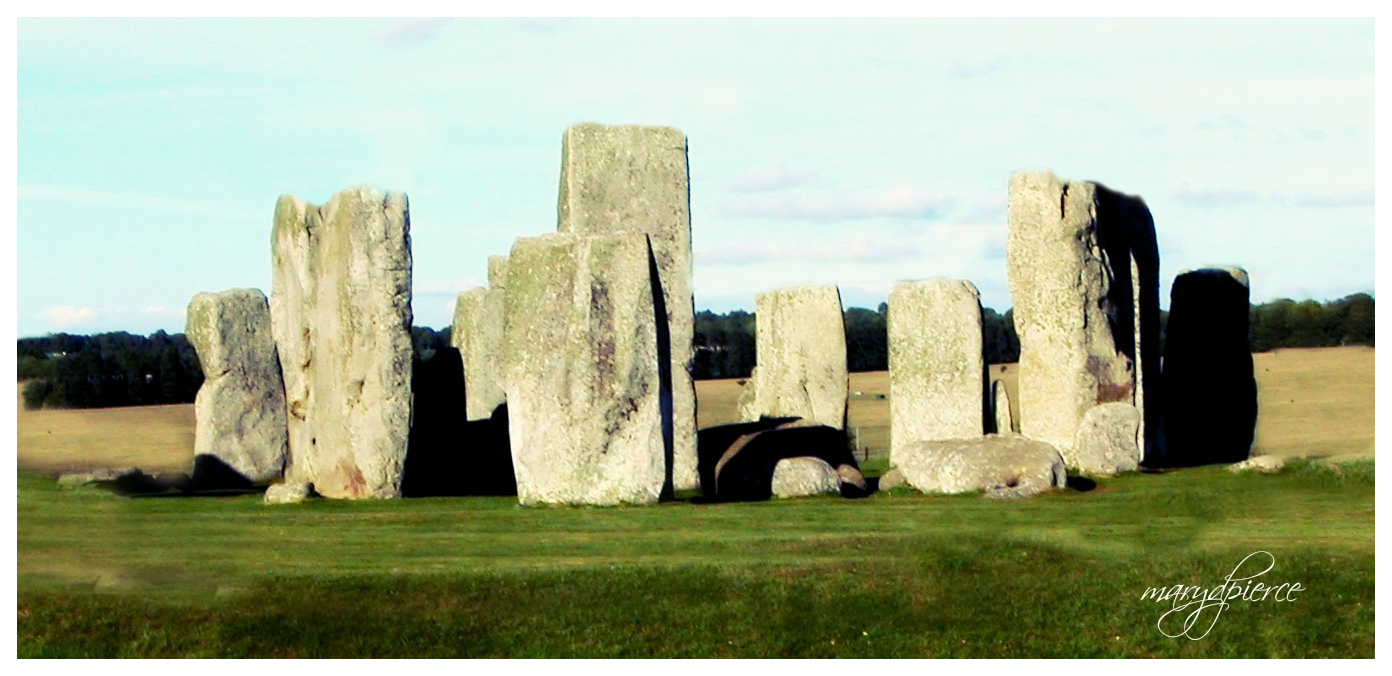
iconic stonehenge pm smaller This is the photo of Stonehenge that set my grandfather’s heart ablaze.

There are variations of my grandfather’s story, but I prefer this one.  Mostly, because it came from my great-aunt Sophie, and she never said anything that wasn’t true.  Or at least, true enough.  She was the keeper of our stories.  From births to deaths, weddings to wakes; new jobs, new homes, new dreams, if it involved a Webster, Aunt Sophie wrote it down.  That job fell to me a few years ago when, at the age of eighty-two, she fell off her bicycle, hit her head, and died.

(Let that be a lesson for you — You are never too old to wear a helmet.  Aunt Sophie would back me up on this if she could.)

This story began fifty years ago when Grandpa Webster had a dream.  In it he dreamed that his ancestors had been druids, and this pleased him immensely.  The whole wise man, mystical nature thing.  He thought it might be true.  But, when he told others about it, they said — Don’t be daft, you foolIt’s just a dream.  So he shut up about it.

Still.  A wisp of the dream remained.

Shortly after that grandpa bought a box.  He was fond of auctions, and even fonder of bidding on blind boxes – blind in the sense that you had no idea of the contents but were willing to chance that there might be something of value inside.  In this instance, the thing of value was the tinted photo of Stonehenge you see above.

How that photograph took hold of my grandfather.  He kept it on his nightstand.  It was the last thing he looked to before he closed his eyes, and the first thing he saw upon waking, his wife coming in a poor second.  But she was patient because she loved him.  And she knew about his druid wish.  For even a wisp of a dream carries a sweet, smoky odor that a good spouse can smell.  She went to the public library and brought back a book — The Stonehenge Myth — and set it next to the photo on my grandfather’s side of the bed.

My grandparents owned a small farm at the time.  Eighty acres on which they grew corn and wheat and raised chickens, sheep, and some dairy cows.  (My father grew up on this farm and knew before he was eighteen that he wanted something else in life, but that’s another story, for another time.)  Four months after his finding the Stonehenge photo, six months after the druid dream, my grandfather dragged home his first big rock, a four foot by two foot slab of stone that he slid off the back of a flat-bed trailer at the end of the sheep field.  The neighbors wondered what use could be made from a stone that size, but my grandmother had an inkling.

Over the next six months, my grandfather brought home twelve more boulders and stone slabs of various sizes.  He paid his four strapping boys and their friends to help him arrange the stones in a circle.  He borrowed a backhoe and a front end loader.  He carried the Stonehenge photograph in his shirt pocket, and when people asked him what in blue blazes was he trying to build, he pulled out the photo and handed it to them.

This, he said.  I’m building this.  It’s iconic.

Some people thought he said ironic.

Over the years, my grandfather and his folly became legend.  There were stories told that he danced drunken and naked in the moonlight among those stones.  Aunt Sophie said that wasn’t true.  She said that he simply found comfort in sitting in that stone circle while the sun rose or set and he could think about the day ahead of or behind him.  It brought him peace.

For my father and his brothers, it brought them something else.  There were more than a few times when they and their friends dared one another to strip and whoop it up around the rocks.  For them, it was a level of coolness others didn’t have.

We were the only kids with Stonehenge in our back yard.

Fifteen years ago, as my grandparent’s fiftieth wedding anniversary approached, their sons wanted to gift them with a trip to England, to see the real Stonehenge, they said.  My grandparents turned them down.  Why spend all that money, when they were happy with the one they had?

I’m no fool, my grandfather told his boys.

It was the truest thing I ever heard him say.

The Webster family Stonehenge that stands in what used to be a sheep pasture on the farm. The stones are not as big as they look, not nearly like those at the actual Stonehenge, but they were good enough for dancing around in the moonlight. The Webster family Stonehenge standing in the sheep pasture on the farm. The stones are not as big as they look, certainly not like those at the actual Stonehenge, but they’re good enough for dancing around in the moonlight.

n.b.  This is not a true story.  It is fiction.  I wanted to see if I had a photo that was iconic to me (for the Weekly WP Writing Challenge), and then make up a story to fit the picture.  Also, I have been to the real Stonehenge.  I wasn’t allowed to dance around the stones, though, naked or otherwise.

The boy who wanted to be a stunt man.

We noticed when he began throwing himself down the stairs.

“What are you doing, trying to kill yourself?”

“No,” he said.  “I’m practicing to be a stunt man.”

Sometimes he’d start at the top of the stairs.  Seized by a heart attack at the age of seven, he’d clutch his chest, crumble to his knees, and then roll – bump, bump, bump – down each step.  Other times he’d start at the bottom and dash up – chased by a knife-wielding or gun-toting villain – only to be stabbed or shot in the back half-way up, whereupon he would crumble to his knees, and then roll – bump, bump, bump – down each step.  Backwards.

When he perfected falling down stairs, he moved on to leaping over trees.  Short trees to be sure, sapling evergreens, but a fair leap for a kid.  Eventually he graduated to flinging himself sling-shot fashion out of bigger trees.

The year my parents took part in a local theater production of Dracula, he pretended to be the lunatic Renfield, and collected flies in a jar.  He went around saying heh heh heh and wringing his hands for a year.

He had a paper route and accidentally set himself on fire.  He graduated high school and started lifting weights.  He grew muscles.  He went to college and studied chemistry.  He thought about becoming a pharmacist.  He got married and had two sons, instead.  When I got married he was best man at my wedding.  He showed up shortly before zero hour in a car with a door that wouldn’t open.

For a while he chased demons.

What happens from there to here?  From boy to man?  From lost to found?  Life.  Life happens.  And we manage somehow to muddle our way through it.

For the love of a good woman (my take on it), he has now found his way to where he needs to be.  He is not a stunt man.  He’s a research scientist/engineer and he would like to go to the moon.  Or at least into outer space.  I think that he is happy now.  Which is the best stunt ever.

He wins.

Boy bundled up & reading on a cold winter afternoon. Stunt boy bundled up & reading on a cold winter afternoon.

N.B.  I started this as last week’s DPChallenge on Character.  I like stories, and what are stories, but a study of character?